A market briefing for importers, distributors and fleet operators looking at Electric Bikes in Uganda sector — what is driving it, what is holding it back, and what an operator needs before committing capital.
Uganda is one of the few African markets where electric two-wheelers are no longer a pilot. There are tens of thousands on the road, a national strategy with a dated target, a president who has personally launched a fleet, and a battery-swapping network that doubled in eighteen months. It is also a market where the constraint has moved: the question is no longer whether riders will accept electric, but whether the infrastructure behind them can keep up.
This article sets out the market first — policy, economics, the social weight of the boda boda sector, and the technology layer — then identifies the four bottlenecks that currently decide which operators scale, and what a new entrant needs in order to clear them.
1. The market at a glance
| Indicator | Figure |
|---|---|
| Motorcycles as a share of registered vehicles | over 60%; more than 400,000 in Greater Kampala alone |
| Petrol boda bodas in Kampala | over 200,000 |
| Electric share of the Kampala boda fleet | about 10% (New Vision, 2026) |
| Battery-swapping stations nationwide | ≈150 (mid-2024) → 350+ (late 2025) |
| Annual saving per rider, electric vs petrol | ≈ UGX 1 million (about USD 255) |
| Government targets | public transport electric by 2030; 100% electric new-vehicle sales by 2040 |
Sources: World Bank, The Battery Under the Seat (September 2026); New Vision (2026); Nile Post (2026). Figures are as reported and dated — verify before using them in a business case.
Read together, those figures describe a market that has crossed from pilot into commercial, but not yet into mass. Ten percent penetration in Kampala is real volume — enough for a distributor to build a business on — and it simultaneously means that nine riders in ten are still on petrol, so the growth runway is the replacement cycle rather than new demand. What sets the pace of that replacement is not the vehicles. It is the 350-station network behind them, and whether it can reach the riders who have already said yes.
2. What shapes this market: policy, economics, society and technology
2.1 Policy: a government that has picked a side
Uganda’s National E-Mobility Strategy, led by the Ministry of Science, Technology and Innovation, sets two dates that matter commercially: public transport electric by 2030, and 100% electric new-vehicle sales by 2040 (as reported by Nile Post, 2026). Those are targets rather than enforceable rules, but they have pulled real actors into alignment — Kampala Capital City Authority has partnered with boda boda associations on a phase-out campaign (reported by New Vision, 2026), and the sector’s own union is now an advocate rather than a sceptic.
The political signal is unusually direct. In July 2024 President Museveni commissioned an electric motorcycle fleet in person, and used the occasion to compare prices: around USD 1,000 for an electric machine against roughly USD 1,480 for a diesel boda (as of 2024). When a head of state launches a vehicle category and quotes its economics, distributors can reasonably read the direction of travel.
Fiscal policy has moved in the same direction. Uganda is among the African markets that have introduced tax breaks and import duty reductions for electric vehicles, alongside Egypt and Kenya. The specific treatment changes with each finance cycle, and we have deliberately not quoted rates here — a distributor should confirm the current schedule with a clearing agent rather than rely on a figure from an article.
2.2 Economics: fuel prices did the persuading
The economics of this market are driven less by environmental policy than by the pump. As of October 2026 petrol in Kampala has climbed to UGX 6,700–7,000 per litre, with diesel above UGX 7,000 — and the pressure is policy as well as market: the 2026/27 budget added UGX 200 per litre of excise duty, while the shilling’s slide from roughly 3,790 to beyond 4,000 to the dollar over the same period added an estimated UGX 300 per litre. For a boda boda operator, fuel is the single largest variable cost after the loan itself, and it is the one they cannot negotiate.
That is what makes the swap model work commercially. A rider pays per swap rather than per litre, which converts an unpredictable input into a fixed one — roughly UGX 8,400 for about 100 km at Spiro’s published rate in the West Nile region (September 2026). The World Bank’s estimate of the resulting saving is around UGX 1 million per rider per year, or about USD 255. For someone earning one fare at a time, that is the difference between a business that accumulates and one that does not.
Access to the vehicle, however, is a separate problem from the cost of running it. Purchase structures in this market lean heavily on asset finance: a deposit in the region of UGX 120,000 followed by daily instalments over two years is the shape reported for Spiro in West Nile, with the total payable materially above the cash price. The World Bank’s diagnostic study names access to affordable financing as the primary remaining barrier to electrifying boda bodas — which is worth remembering before assuming that a lower running cost is sufficient on its own.
2.3 Society: the boda boda sector is the market
In Uganda, motorcycles are not a leisure category that happens to be electrifying — they are the transport system. The sector is the country’s second-largest employer, carrying people, goods and produce across a largely informal network where buses and matatus do not reach. Any product decision here is therefore a livelihood decision, and it is judged on daily cash flow rather than on total cost of ownership over five years.
The public-health argument has become part of the commercial case. With more than 200,000 petrol boda bodas in Kampala alone, each emitting an estimated 5.7 kg of CO₂ a day — figures given by the state minister for Kampala at the launch of a phase-out campaign — air quality is now a stated municipal concern rather than an abstract one. That framing matters for distributors: it means electric two-wheelers are being promoted by city authorities, not merely tolerated by them.
2.4 Technology: swapping solved charging, and created a new constraint
Uganda did not electrify on home charging. It electrified on battery swapping, which removes the single biggest objection a working rider has — hours spent waiting for a pack to fill. A swap takes minutes, and the rider keeps earning.
That choice has a consequence the market is now living with. Swapping turns a vehicle problem into an infrastructure problem: you need land, three-phase power, grid connections, stations, spare batteries, maintenance and battery logistics. The network grew from roughly 150 stations in mid-2024 to more than 350 by late 2025 — real progress, and still thin for a country this size. The World Bank’s modelling puts Greater Kampala’s electric vehicle demand by 2030 at somewhere between 290 and 1,100 GWh a year, which is manageable at system level; the difficulty is when and where it is drawn, because the bottleneck is distribution rather than generation.
Operators are already adapting to that reality. At least one major network is adding solar to its swap stations specifically to insulate itself from grid unreliability — an acknowledgement that in parts of the country, a station without its own generation is a station that stops earning when the power does.
3. Who is already operating
The market is not empty, and a new entrant should assume it will be competing for rider attention rather than creating it. Four names carry most of the volume.
| Operator | Scale reported | Model |
|---|---|---|
| Spiro | 33,000+ in Uganda; 135,000+ group-wide across seven markets company-reported, via Zag Daily, September 2026 | Sell and lease; battery subscription; own manufacturing plants |
| Zembo | Targeting 2,000+ active riders and 80+ charge/swap points (2025) | LFP packs, around 80 km per swap; swap stations on renewable power |
| GOGO Electric (formerly Bodawerk) | 2,000+ motorcycles; 800,000 swaps recorded in 2024 | Manufactures motorcycles and lithium packs locally |
| Mocoo | Retail showroom presence in Kampala | Dealer/retail channel |
Spiro’s figures are company-reported via Zag Daily (September 2026). Zembo, GOGO and Mocoo figures come from secondary trade reporting in 2025–26 and have not been independently verified — treat them as indicative of scale rather than audited counts.
Finance sits alongside the hardware. Microfinance and mobile-money lenders now run dedicated e-boda products, and one partnership has publicly targeted financing 2,000 electric boda bodas by the end of 2026. This is the layer that decides adoption speed — not the vehicles themselves. It also explains why the sector’s own cooperative union has become a distribution channel in its own right: a union that can vouch for a rider is worth more to a lender than any specification sheet.
For comparison across the region, we have covered Kenya, Rwanda and South Africa in the same series. The bottlenecks are recognisably similar; what differs is maturity, and Uganda currently sits ahead of most of its neighbours on swap infrastructure.
4. The four bottlenecks that decide who scales
If the market is already moving, the interesting question for a new operator is not “is there demand” but “what is stopping it from going faster”. Four things are.
4.1 Swap-point density, outside Kampala especially. A national network of 350 stations sounds substantial until it is mapped. In the West Nile region, Spiro had only two three-phase swap points serving an area where 250 motorcycles had already been sold and more than 700 approved applications were waiting for delivery. Riders were not refusing the product; they were waiting for a place to charge it. This is the clearest gap in the market, and it is not solved by shipping more vehicles — which means a new entrant’s addressable market is defined by where they can site a station, not by where riders live. A distributor who cannot put equipment on the ground is confined to the coverage of whichever network they buy into.
4.2 Grid connection and power reliability. Swap stations need three-phase power, and they need it continuously. Where the grid is weak or intermittent, a station becomes a bottleneck rather than an asset, and the operator carries the cost of the downtime. This is why solar-plus-storage is appearing on station designs — not as a green gesture, but as an availability requirement. The practical consequence is that the real cost of a station is not the cabinet alone: it is the cabinet, plus the connection, plus whatever backup is needed to keep it running through an outage. Operators who budget for the equipment only tend to find this out at commissioning, when the ground has already been leased.
4.3 Financing. High upfront cost against irregular income is the structural problem, and the World Bank names access to affordable credit as the primary remaining barrier. Any operator entering this market is, whether they intend it or not, also entering the consumer-credit business. That has an upstream implication most suppliers ignore: a distributor who is financing riders downstream needs longer and more flexible terms from the factory, not just a competitive unit price. A quotation built on 30% deposit against the bill of lading does not answer the constraint the distributor actually faces.
4.4 Service and spare parts at distance. A motorcycle that is 300 km from the nearest workshop and waiting on a controller is not a vehicle, it is a stranded asset. Networks that scale in East Africa are the ones that solved parts logistics early; the ones that did not, discover the problem in year two, when the first packs and controllers start failing in volume and the riders who cannot get a repair stop paying their instalments.
Set out side by side, the four bottlenecks convert into a fairly specific specification list — and it is a list that a vehicle quotation on its own does not answer:
| Bottleneck | How it shows up | What the operator needs |
|---|---|---|
| Swap-point density | Riders approved and waiting; national network does not reach them | Swapping or charging equipment they can site themselves |
| Grid reliability | A station that stops earning when the power does | Solar generation with battery storage, sized to the station |
| Financing | Upfront cost against daily income; credit is the binding constraint | Supplier terms that let a distributor extend credit downstream |
| Parts and service | Vehicles idle for weeks over a single component | A first-year spares package and technician training, not a catalogue |
5. What an operator therefore needs
Read the bottlenecks together and the requirement list writes itself. An operator entering Uganda does not only need vehicles — they need a package that keeps the vehicles earning. For the procedural side of getting that package into the country — documentation, pre-shipment inspection, payment terms — our guide to importing electric bikes, scooters and mopeds from China covers the sequence in order.
- Vehicles specified for local duty — sustained load, unpaved roads, high ambient temperature, and riders who work a full shift rather than a commute.
- Swap or charging equipment they can site themselves, so coverage is not entirely dependent on a national network’s expansion timetable.
- A power solution that survives an unreliable grid — solar generation with storage, sized to the station rather than to a headline.
- Spare parts and training structured around the first year of operation, not a catalogue.
- A financing structure that matches rider income — which usually means the supplier’s commercial terms have to accommodate a distributor who is extending credit downstream.
That is a different purchase from a container of motorcycles. It is also where most suppliers stop — they sell vehicles, and leave the station, the power and the parts to someone else.
6. Where BENLG fits
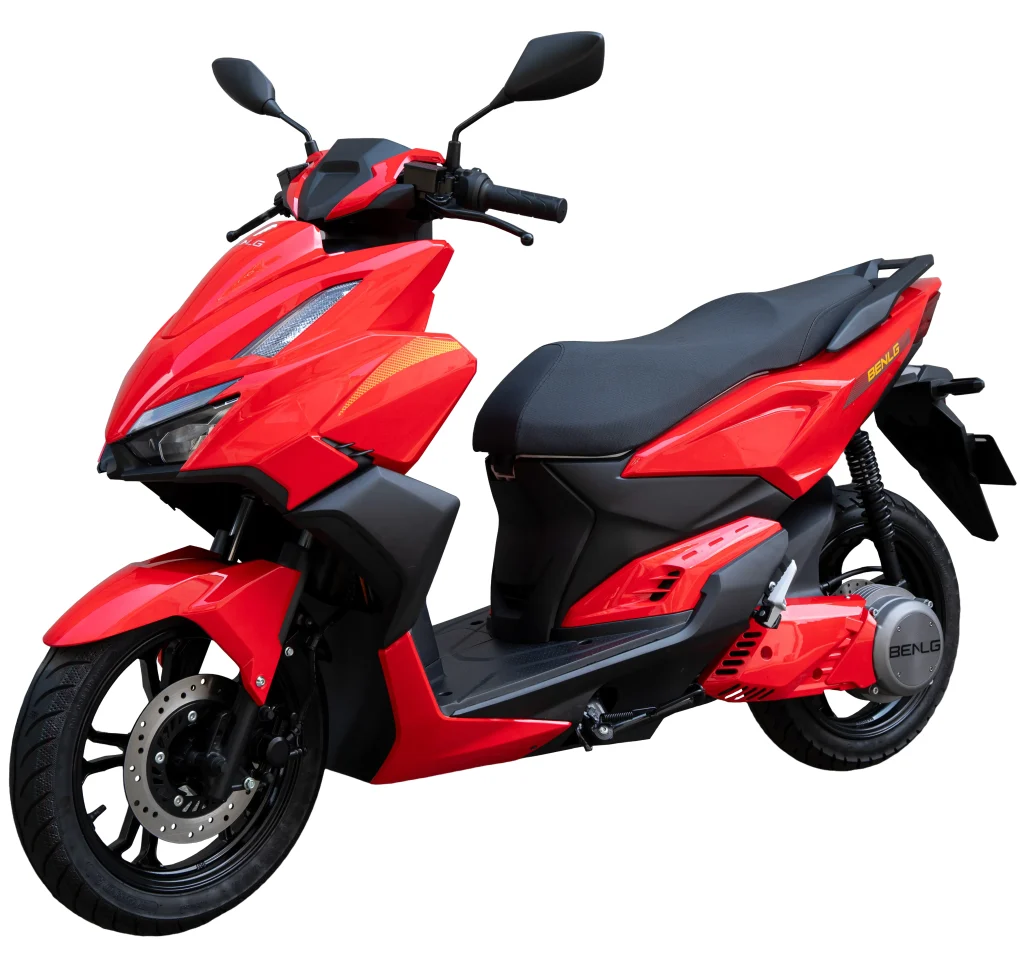
We manufacture electric motorcycles, mopeds, bicycles and tricycles in Dongguan, Guangdong, and have done since 2003. Most of the importers and distributors we work with are buying one of three things: a private-label programme on a platform they have approved, a mixed first container of two to four models to test a market, or supply in CBU, SKD or CKD form depending on whether they assemble locally.
On the bottlenecks above, vehicles are the part we build ourselves. But a container of motorcycles does not answer the problems in Section 4, so we also assemble two things alongside them for operators who need the full package: battery-swapping cabinets, for a distributor or fleet operator who wants to site their own swap points rather than wait for national coverage, and solar generation with battery storage, for locations where the grid cannot be relied on to keep a station running.
To be precise about the boundary: we manufacture the vehicles, and we source and integrate the swap cabinets and the solar-storage equipment as part of a project. We are not a solar manufacturer. What we can do is put the three together, size them against each other, and quote them as one shipment — which for a distributor is the difference between assembling a system from three suppliers and buying one.
We have written separately about how that combination works in practice, including the case for converting an existing petrol fleet rather than replacing it. If you are still testing whether this market supports a business at all, our guide to starting an electric motorcycle business sets out the commercial model before the equipment question comes up.
If you are evaluating Uganda, the most useful thing to send us is the operating model you have in mind — dealership, fleet, or swap-station operation — the regions you intend to cover, the volumes you are considering, and whether you plan to assemble locally. That is enough for us to come back with a configuration and a landed cost rather than a catalogue.
📩 Contact the BENLG export team about a Uganda project | 💬 WhatsApp answered during China business hours.
Sources. World Bank, The Battery Under the Seat: How Uganda is Gearing Up for Electric Mobility at Scale (21 September 2026); Zag Daily on Spiro’s fleet and financing (September 2026); AllAfrica / The Independent on swap-point shortages in West Nile (September 2026); New Vision on financing and fleet share (2026); Nile Post on fuel costs and the shift to e-mobility (2026); Daily Monitor on Kampala pump prices (10 October 2026); Uganda Today on the move to UGX 7,000 and the excise measure (October 2026); State House Uganda on the 2024 commissioning (as of July 2024). Market share, station counts and pump prices are as reported at those dates and will have moved; confirm current figures before committing capital.