Abidjan moves on two wheels. Government estimates put roughly 400,000 two- and three-wheelers in the Greater Abidjan area, and almost all of them burn petrol. Electric models remain a small share of that fleet, but they are no longer a curiosity. The city has brand stores for them, its own classifieds groups, and a price spread wide enough to confuse a first-time buyer.
October 2026 changed the ground under that market. A national registration operation for two- and three-wheelers opened on 1 October at a flat fee of 14,100 FCFA, and checks on unplated machines were stepped up from 15 October. A bike sold without papers last year is now a liability for whoever owns it.
This guide covers what an electric motorcycle Abidjan buyers can actually register costs, and what is on sale in the city. It sets out what the paperwork requires and how charging works where there is no swap network. For readers who want to supply the market rather than ride in it, it closes with what importing involves.
What an electric motorcycle costs in Abidjan
Listings in the city run from around 120,000 FCFA for small imported models to more than 800,000 FCFA for long-range machines. Branded retail sits in the middle: REVOO, one of the most visible electric brands in Abidjan, advertises its models from 350,000 FCFA upward.
That spread is not marketing. Five things move the number, and they move it independently of each other.
| What drives the price | Why it moves the number |
|---|---|
| Battery chemistry and capacity | A lead-acid pack is cheaper on the day and dies sooner. A lithium pack costs more and holds its capacity longer. Range is bought in kilowatt-hours, and that is the single largest line in the price. |
| Motor rating | A 1,000 W motor and a 3,000 W motor are different vehicles in Abidjan traffic, and different again on the hill roads and with a passenger on the back. |
| Assembled locally or imported complete | A unit assembled inside Côte d’Ivoire carries a different duty base and a smaller shipping bill than one that arrives complete. Local assembly is no longer hypothetical: Facigoo says it assembles and tests its motorcycles in the country. |
| Paperwork | A machine cleared and registered properly costs more than one that arrived without documents. Since October 2026 the second kind cannot be used on the road, so the saving is temporary. |
| Service | Whoever stocks brake pads, tyres, chargers and replacement batteries for that model is part of the price, whether or not it appears on the invoice. |
Running cost is where the case is strongest, but it has to be done per kilometre. A tank and a battery hold different amounts of energy, so comparing the price of one fill with the price of one charge says nothing useful. What matters is what 100 km costs.
| Per 100 km | Petrol moped | Electric moped |
|---|---|---|
| Energy used | 2.0–2.5 litres | About 3 kWh |
| Unit price | 905 FCFA per litre, the regulated pump price since 1 August 2026 | Around 80 FCFA per kWh, the residential average |
| Energy cost | 1,810–2,263 FCFA | About 240 FCFA |
Two of the inputs decide the result, and both can be checked. The pump price is set by the hydrocarbons directorate and was raised to 905 FCFA a litre for super sans plomb on 1 August 2026. The electricity figure is the residential average of about 80 FCFA per kWh, which is the conservative choice. Households on the social tariff pay less for the first tranches, and a two-wheeler adds only a few dozen kilowatt-hours a month.
The consumption figures are where you should substitute your own riding. A 110–125 cc moped uses roughly 2.0–2.5 litres per 100 km. An electric scooter that covers 70 km on a 2 kWh pack works out at about 3 kWh per 100 km. Change either number and the gap moves, but the order of magnitude does not: on these inputs, the electric bike costs between a seventh and a ninth as much to move.
Two things can erase that saving. A pack that fails outside warranty turns eight years of fuel savings into one invoice, and a small pack cycled twice a day ages faster than the odometer suggests. That is why the warranty on the battery matters more than the warranty on the frame. It is also why a removable pack with a known replacement price beats a slightly larger fixed one.
What the electric motorcycle Abidjan market actually offers
Supply runs through three channels that are not interchangeable, and the difference between them is mostly paperwork and service rather than hardware.
Brand retail. REVOO advertises stores in Yopougon, Koumassi and Cocody, and a one-year, 10,000 km warranty. Facigoo sells models it says are assembled and tested locally. Ivoire Moto, a motorcycle dealer in Abidjan, lists an electric line alongside its petrol models. CACOMIAF lists a CAMICO EU3. Buying through this channel buys a plate, an invoice and someone to call.
Online marketplaces. Jumia lists electric models by category, and CoinAfrique and cari.africa carry classifieds. A Facebook group dedicated to electric motorcycles and bicycles in Abidjan works as the real trading floor for used and grey-market units. Prices are lower here, and provenance is often unclear.
Individual imports. One or two units brought in by a seller who saw a margin, often lead-acid, often without a carte grise. This is where the 120,000 FCFA end of the market comes from, and it is the channel the October operation was designed to close.
What the market does not have is a battery-swap network. Spiro, the largest operator on the continent, runs more than 100,000 electric motorcycles and 2,500 swap stations across seven African markets, and Côte d’Ivoire is not one of them. That absence shapes every buying decision below: the battery is yours to charge and yours to replace.
Registration: what the October 2026 rule changes
The national operation covers two- and three-wheelers that have no plate, at a flat 14,100 FCFA. The enrolment window opened on 1 October and runs for six months, and checks on unplated machines were stepped up from 15 October. The operation is framed around road safety and traceability, and the case for it is easy to see: an unplated bike is hard to trace after an accident.
The scale of the backlog explains why the operation exists. Government figures reported in the local press put 222,578 vehicles registered between January and September 2026, of which 93,133 were two-wheelers — a fraction of the fleet on the road.
For a buyer, the practical consequence is simple: a machine without a carte grise has no resale value above its scrap price. For a dealer, it is sharper. Stock that arrived without documentation can no longer be sold as a road vehicle. The cost of registration has to be absorbed before the unit leaves the shop, not discovered by the customer at a checkpoint.
For electric models specifically, the plate follows the category the vehicle falls into, and that category is set by power and speed rather than by the badge on the side. The specification sheet decides what happens at the counter, months before it decides anything on the road.
Licence, insurance and the paperwork around a plate
Côte d’Ivoire writes its motorcycle licence in three sub-categories. Article 134 of the 2016 road decree (décret n° 2016-864) puts mopeds with a thermal engine under 50 cm³ in A1, machines from 50 to 125 cm³ in A2, and anything above 125 cm³ in A3. Article 139 fixes the minimum age at 16 for A1 and 18 for A2 and A3. The public service portal puts the state fee at 18,500 FCFA, alongside a pass in the code and the driving test and a minimum of one month. That figure covers the administration only. Tuition at a driving school is billed separately and sits on top of it.
Mopeds carry a rule of their own. Article 195 requires anyone riding a cyclomoteur to hold a licence de conduite issued on terms set by the transport minister, and Article 197 puts the minimum age for a cyclomoteur rider at 14.
What the decree describes and what the ministry issues are not the same thing. Its page on licence validity states that the A1, A2 and A3 split, and the ten-year validity attached to it, are not yet in force. What is issued today is a single category A licence for machines of 50 cm³ and above, and it does not expire. The ministry’s published procedures describe no separate application for a moped licence.
That leaves the electric model in an unusual position. Article 134 sorts vehicles by cylinder capacity, and an electric motor has none, so a 45 km/h electric moped is not placed in a category by arithmetic. Its class is settled when it is presented for registration, and that decision tells the customer which document to hold. A dealer advertising a bike as needing no licence is taking a position the decree does not settle, so the answer is worth having in writing before it goes on a poster.
Pedal-assist bicycles are the one category where the licence question rarely comes up. Article 3 defines a cycle as a machine propelled exclusively by muscular energy, and a cyclomoteur as any cycle fitted with a motor under 50 cm³, which on the letter of the text puts a powered bicycle into the moped class. On the road, low-power pedal-assist models are treated as bicycles and ridden without a licence. That makes them the simplest first sale in this market, so long as motor power and assisted speed keep the model on the bicycle side of that line.
Two things follow from that. There is no moped-specific shortcut a dealer can promise, because the licence in circulation is the same one a 125 cc rider holds, and a customer who later moves up to a larger machine does not need a second one. Insurance and a helmet sit alongside the plate as the baseline for riding legally, and fleets carry additional cover for riders who are not the owner.
Charging in a city without a swap network
With no swap network and few public points, charging happens at a wall socket, at home or at the shop where the bike was bought. That is not a stopgap; it is the operating model, and it works because the pack is small enough to fill overnight.
Public charging exists, but it was built for cars. illigo describes the site it built with Pétro Ivoire as the largest public charging site in the city: three 60 kW DC points with two connectors each, plus ten AC points. Neither helps a two-wheeler much. DC fast charging needs a vehicle designed to accept it, and the AC points carry the car-standard socket, which a bike’s portable charger cannot use without an adapter.
That is why the plug on the bike matters more than the map of charging stations. Most models in this class arrive with a portable charger that ends in a domestic plug; few have an on-board charger with a public AC inlet. For a fleet, the useful question is not where the nearest public point is, but how many wall sockets the depot can dedicate to charging overnight.
| Where it charges | Who it suits | What to confirm first |
|---|---|---|
| Domestic socket at home | Private buyers, one shift a day | Charger input voltage, cable length, whether the pack can be carried upstairs |
| Socket at the shop or depot | Delivery riders, small fleets | Number of chargers per bike, load on the building’s supply, who supervises charging |
| Public AC point | Cars rather than two-wheelers | Whether the bike has an on-board charger that accepts the car-standard socket |
Two questions separate a workable purchase from an expensive one. Can the pack be removed without tools, and is a second pack available at a sensible price? In a market with no swap operator, a removable pack is what turns a charging stop into a battery exchange you perform yourself.
The gap is not unique to two-wheelers. RFI reported in June 2026 that more than a thousand electric vehicles were in circulation in Côte d’Ivoire, concentrated in ride-hailing. Its report put insufficient charging points among the three brakes on adoption, alongside purchase price and dependence on imported parts.
Heat, load and roads: the specs that decide whether a bike lasts
Three local conditions shorten the life of a machine that was specified for a European city: sustained heat and humidity, two adults plus cargo, and road surfaces that alternate between broken asphalt and sand.
| Specification | Why it matters here | What to ask |
|---|---|---|
| Battery thermal behaviour and IP rating | Heat is one of the main causes of early capacity loss, and the rainy season puts water where a car does not go | IP rating of pack, controller and display; the temperature at which the BMS cuts off charging |
| Rated load and frame | Two passengers and a load are normal use, not abuse | Rated payload, rack mounting points, whether the rear frame is reinforced |
| Suspension and wheel size | Small wheels and short travel transmit every pothole into the frame and the pack | Travel front and rear, tyre size, and whether tyres are available locally |
| Brakes | A loaded bike in traffic wears pads faster than a solo commuter | Disc or drum, and who stocks the pads |
| Parts supply | A model with no local parts is a model that waits for a part | Which consumables ship with the container, and what the importer commits to stocking |
None of this is exotic. It is the difference between a specification written for a catalogue and one written for a city where the bike is a working tool.
If you are importing rather than buying one
Anyone importing an electric motorcycle Abidjan dealers will resell is pricing a landed unit, not a factory unit. Electric two-wheelers clear under HS 8711.60 like any other motorcycle. Duty, VAT and the broker’s fees stack on the CIF value, which is why the same model can be quoted at two very different prices by two importers. Confirm the current rates with a broker before pricing a container. What sits inside that landed number is broken down item by item in the price guide for Kenya.
How the unit arrives changes both the freight bill and the duty base.
| Shipping form | What arrives | What you need |
|---|---|---|
| CBU | Complete vehicles, ready to plate | Capital and warehouse space; the fastest route to a showroom |
| SKD | Partly assembled units, major assemblies together | A workshop, a few tools and a team that can follow assembly instructions |
| CKD | Knocked-down kits, packed for volume rather than for speed | Assembly capability, quality control and a plan for the first units that come out wrong |
The trade-off between the three is set out in more detail in the guide to CBU, SKD and CKD shipping, including how lithium batteries have to be packed and declared.
Homologation is the constraint that catches first-time importers. The documents that come with the container are the same ones the registration office will ask for. A supplier who cannot produce a specification sheet, a certificate of conformity for the destination market and a battery test report is a supplier whose units may sit in a warehouse. The selection guide sets out how to compare models before the order rather than after.
Local assembly is also moving. Facigoo already assembles in the country, and a dedicated electric motorcycle assembly plant has been announced in Bouaké. That should push the price floor down over the next few years, which means an importer competing only on the cheapest container will be undercut by the assembler next door. The defensible position is specification, spare parts and service, not the last 10,000 FCFA of landed cost.
For a market where those rules are already written up, the Morocco briefing covers duty, homologation and battery transport documentation in detail.
Five questions are worth putting to any supplier before a deposit:
- Which certificate covers this exact model for this market, and can you send the document rather than the badge?
- What is the rated payload, and does the frame change for the cargo version?
- What is the IP rating of the pack, and what does the BMS do in 40 °C ambient heat?
- Which spare parts ship with the first container, and which ones can be ordered separately?
- If the model is revised, how long will the battery form factor stay the same?
The one strategy to avoid is chasing the bottom of the market with unplatable stock. Since October 2026, a container of machines that cannot be registered is not a cheap inventory; it is a write-off with freight attached.
Where BENLG fits
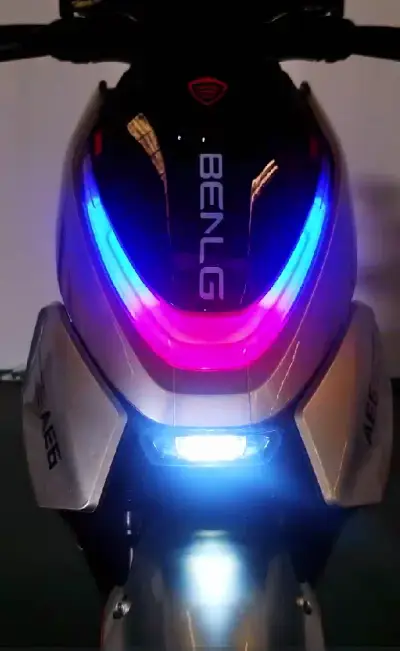
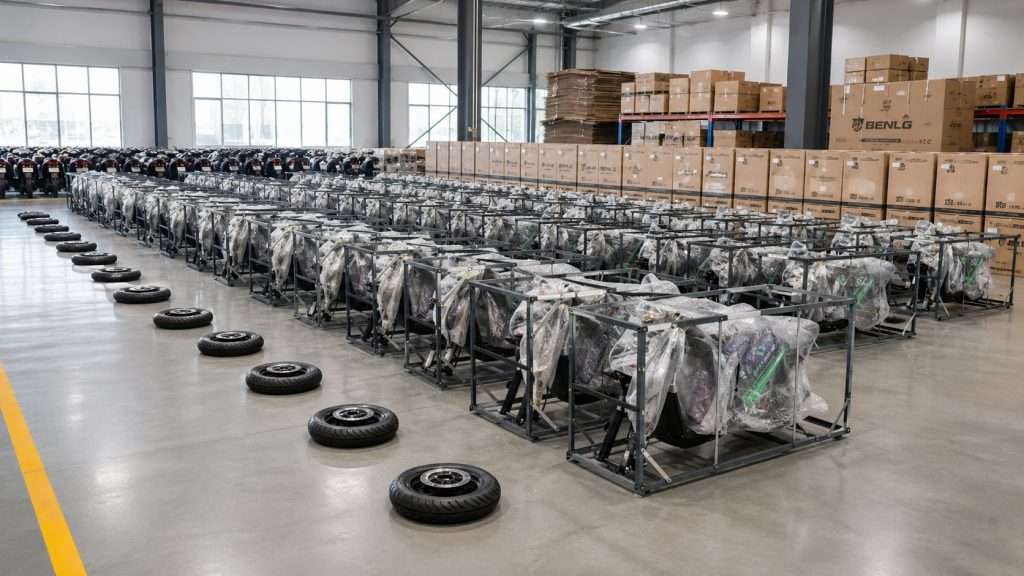
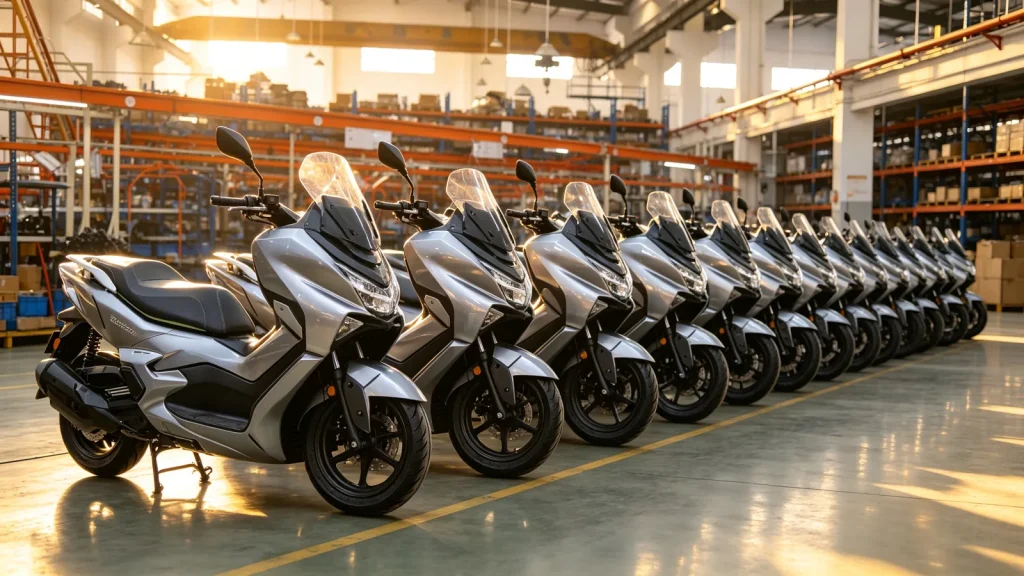
BENLG builds electric two- and three-wheelers in Dongguan, China, as part of a motorcycle business that has been manufacturing since 2003. Our customers are importers, distributors and fleet operators. We do not run retail stores and we do not sell single units.
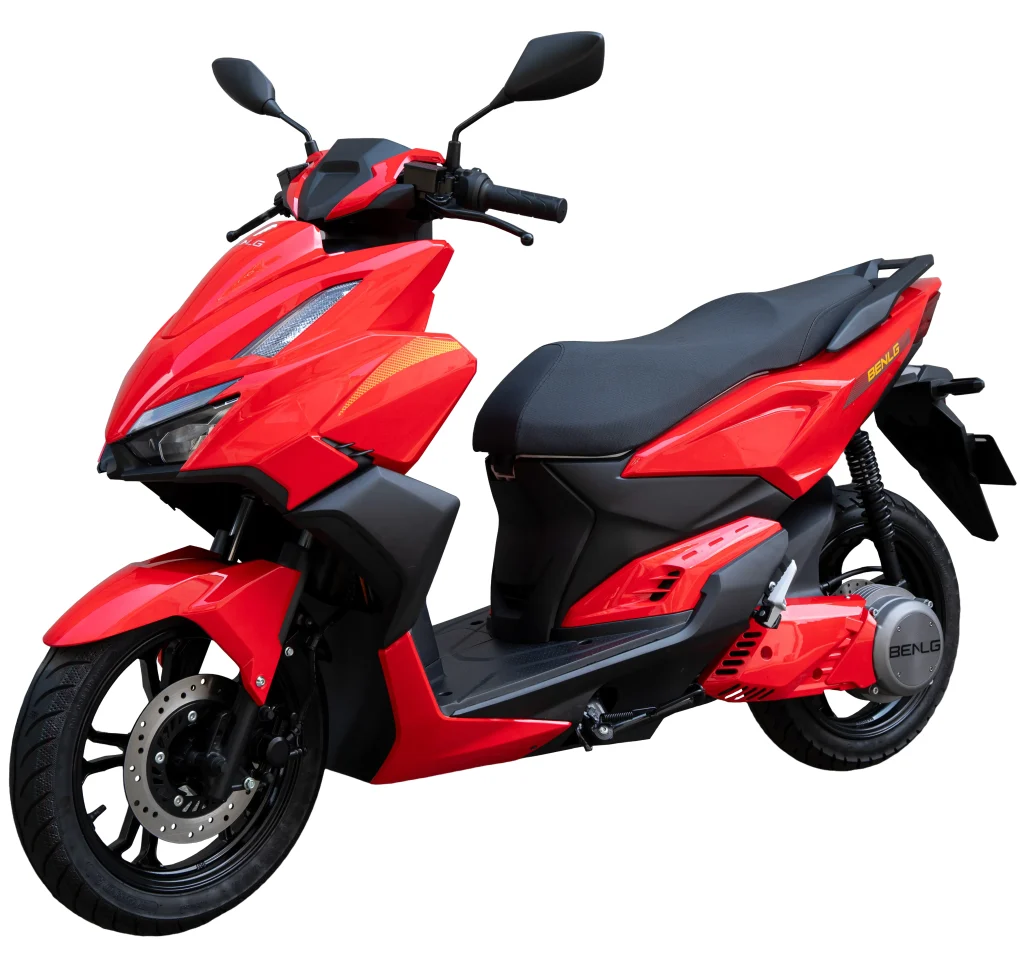
Three of our lines are relevant to this market. City commuters cover 10-, 12- and 14-inch scooters and mopeds in the L1e–L3e band, the type of machine that fits Abidjan traffic. Delivery and fleet two-wheelers use heavier frames, longer range and load-rated racks for riders who carry goods rather than passengers. Pedal-assist bicycles, including scooter-style models with pedals, cover the riders who want the commute without the licence question.
We supply complete vehicles, partly assembled units or knocked-down kits, depending on your duty structure and assembly capability. We also build to your specification, your plastics and your decals under OEM or ODM. Certification is scoped with the quotation rather than after it, because whether a model can be plated decides whether the container was worth landing. What we currently hold is listed on our certificate page, and the tooling and volume side of white-label production is covered on our OEM and ODM page.
If you are working on Côte d’Ivoire, tell us the model, the market and the volume and we will come back with a specification and a quotation.
Frequently asked questions
How much does an electric motorcycle cost in Abidjan?
Prices for an electric motorcycle Abidjan shops advertise start around 350,000 FCFA for branded models, while classifieds run from about 120,000 FCFA for small imports to more than 800,000 FCFA for long-range machines. The difference is mostly battery capacity and chemistry, motor rating, and whether the unit was assembled locally or imported complete.
Do I need a licence to ride one?
Yes. The decree sets out three sub-categories — A1 for mopeds, A2 from 50 to 125 cm³, A3 above that — but the transport ministry states that the split is not yet in force and that what is issued is a single category A licence for machines of 50 cm³ and above. Because an electric motor has no cylinder capacity, its class is settled at registration. Get that in writing before advertising a bike as licence-free. Pedal-assist bicycles are the exception in practice: they are ridden without a licence, although the decree leaves that boundary to be read rather than stated.
Can I charge it at home?
In practice, that is how most of them are charged. A domestic socket will fill a two- to three-kWh pack overnight. What you need to confirm before buying is the charger’s input voltage, whether the pack can be removed and carried, and whether a second pack is available at a sensible price.
Is there a battery-swap service in Abidjan?
Not from a network operator. Spiro, the largest swap operator in Africa, lists seven markets and Côte d’Ivoire is not among them. Public charging points exist, including the illigo site built with Pétro Ivoire, but they were designed around cars and their DC connectors are of little use to a two-wheeler.
Do electric motorcycles have to be registered?
Yes. The national operation that opened on 1 October 2026 covers two- and three-wheelers without plates at a flat fee of 14,100 FCFA, and checks on unplated machines were stepped up from 15 October. A machine without a carte grise cannot be used on the road and has little resale value.
Is it cheaper to run than a petrol motorcycle?
Per 100 km, yes, by a wide margin. At 905 FCFA a litre and about 80 FCFA per kWh, a petrol moped covering 100 km burns 1,810–2,263 FCFA of fuel, while an electric one uses roughly 3 kWh, or about 240 FCFA. The purchase price is higher and the battery decides whether the saving survives, but the running gap is not close.
Sources
Market and policy figures in this article come from the following: RFI, 17 June 2026, on electric vehicles in circulation in Côte d’Ivoire and their running costs; TechCabal, 18 July 2026, on GoCab’s Abidjan fleet and on Spiro’s network; the DGTTC, the transport directorate that runs vehicle registration, for the October 2026 operation; Koaci, 31 July 2026, for the August pump prices; GlobalPetrolPrices, for the residential electricity tariff; Capmad, on the 2026 VTC tax change and charging infrastructure; the transport ministry’s page on licence validity, which states that the A1, A2 and A3 split is not yet applied; décret n° 2016-864 itself, articles 134, 139, 195 and 197, for the categories as written; and UN Comtrade data compiled by TradingEconomics, for imports of motorcycles from China. Retail price ranges are taken from public listings by sellers in Abidjan and are quoted as market reference, not as an offer.