Electric Moped Reviews: The BENLG Flare — What the Specs Mean in Daily Use
Every electric moped review recites the same numbers. Fewer explain what those numbers add up to on a Tuesday morning — how much energy is actually in the battery, why a 760 mm seat height changes who can ride the bike, what 10-inch wheels cost you on a bad road. This review of the BENLG Flare goes spec by spec and shows the arithmetic and the trade-offs behind each one — starting with the one feature everyone photographs first.
The Class It Sits In
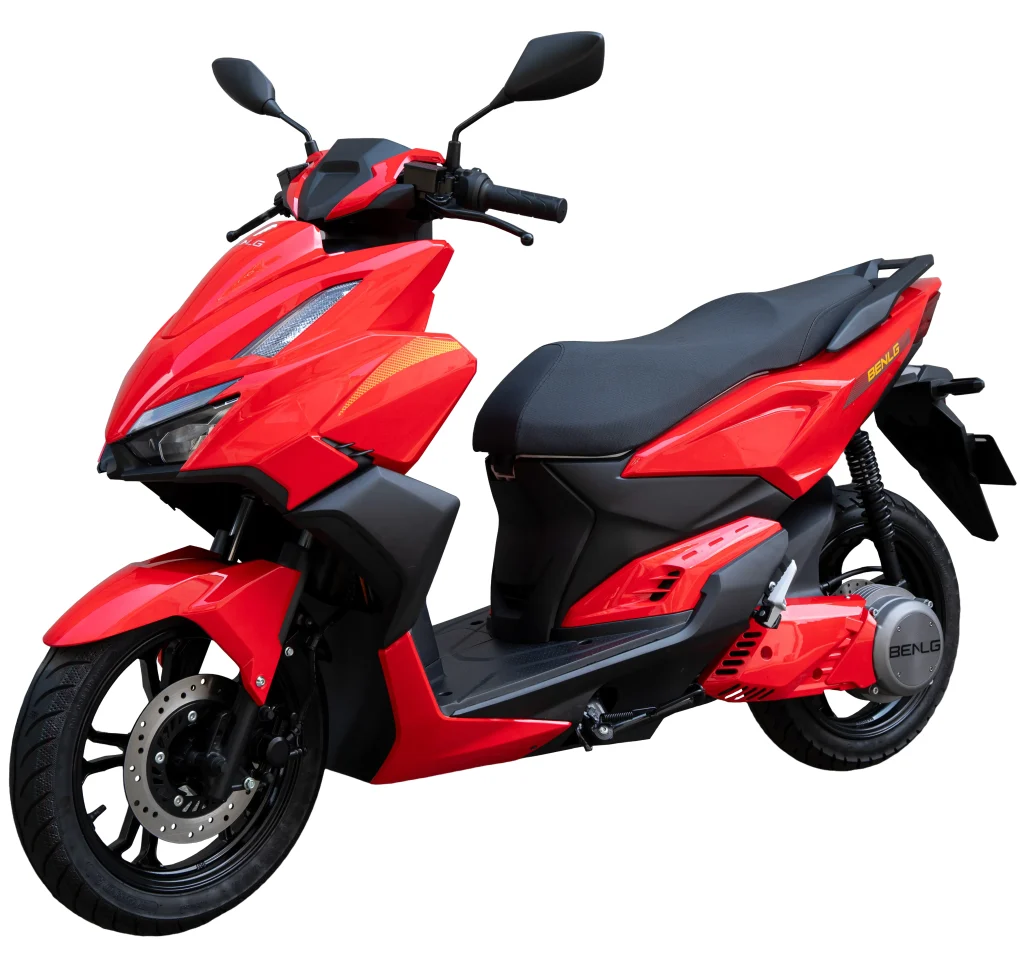
The Flare is a light urban electric moped in the 50 km/h class: 1850 × 680 × 1180 mm on a 1300 mm wheelbase, a 1000W hub motor, and a lead-acid 60V / 72V 35Ah pack. That is not a commuter pretending to be a motorcycle. It is a city machine — built to filter traffic, park in half a space, carry a passenger and a bag, and cost little to run. Judged as what it is, it is one of the more thoughtfully resolved packages in its class. Judged as something else — a highway tourer, a hill-climber for mountain towns — it will disappoint, and we will get to that.
The U-Shaped Light Signature
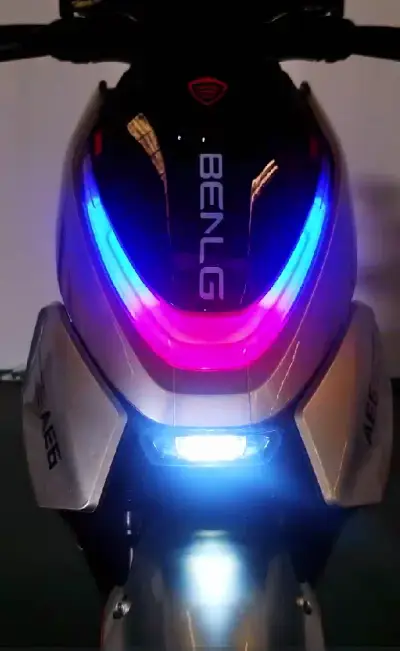
This is the Flare’s face, and the reason most people remember it. A single U-shaped RGB light strip wraps the entire front fascia — edge to edge, curving down both flanks — set into a glossy dark cowl with the BENLG wordmark down the centre and the main LED headlight mounted below as a separate unit. Switch on the low beams and the strip illuminates in sync; the colour shifts along its length, so at night the bike reads as a moving light signature rather than one more anonymous headlight in a mirror.
Two arguments for it — one commercial, one practical. Commercially, this is the stoplight-glance feature: in a market full of round-headlight retro clones, the Flare’s angular, digital face is the opposite of forgettable, and a lit front end sells the bike in a showroom photo before anyone reads a spec sheet. Practically, a high-contrast signature spanning the full width of the front makes the machine conspicuous to other traffic at night — at junctions, on side streets, in rain — where a single headlight tends to disappear. Visibility is a safety spec. The Flare happens to make it look good.
It comes in two versions. The colour-shifting RGB strip is the full-effect version. The standard LED version keeps the same U silhouette at a lower price point — the identity without the effects, which is the version most fleet buyers specify. Either way, the light signature is not an accessory bolted on afterwards; it is designed into the front of the machine.
Fit: What 760 mm Buys You
Seat height is the spec that decides who can actually own a bike, and the Flare’s 760 mm is low — below the norm for the class. The practical meaning: a rider around 160 cm can plant both feet flat at a stop; a rider at 150 cm can manage comfortably; even tall riders are not folded up, because the 1850 mm length leaves real legroom rather than a scooter knee position.
The 680 mm width keeps the profile narrow for filtering between cars and rolling through doorways. Put together — low seat, compact footprint, 60 kg chassis — the Flare is approachable for riders stepping up from a bicycle or an e-bike, and for anyone who has ever dropped a heavier machine in a parking lot and resented it since.
Weight and Balance: The Point of the Footboard Battery
Lead-acid energy is heavy energy. A 35 Ah pack at 60–72V carries real mass — and that is precisely why where you put it matters more than how much of it there is.
The Flare puts the pack in the footboard, not under the seat and not behind the rider. Two things follow. First, the centre of gravity drops to the lowest point on the machine: slow-speed manoeuvring, U-turns and parking-lot shuffling feel planted instead of top-heavy. Second, the entire under-seat area becomes a genuine storage bucket — deep enough for a full-face helmet or a daypack — instead of a battery compartment with a lid.
The trade-off is honest and worth stating: lead-acid is heavier per watt-hour than lithium. What the Flare does is turn that mass into a handling asset by placing it low. If your operation runs on cycle life and swappable packs rather than purchase price, a lithium-powered alternative is the better tool — the chemistry trade-offs are covered in our battery guide.
The Powertrain: What 1000W Actually Does
A 1000W hub motor on a light machine is honest city power. The envelope, stated plainly: acceleration is brisk up to about 30 km/h, the pull to the 50 km/h ceiling is steady rather than urgent, and the bike holds 40–50 km/h on the flat with a single rider without complaining. Add a passenger and a steep, sustained climb and it will slow down — 1000W is sized for urban duty, not mountain passes. Two-up on gradients, expect the pace to drop; on city-average slopes with one rider, it is unremarkable in the best way.
The controller is a 60/72V 12-tube unit — headroom for the motor’s current demands, smoother delivery than the minimum viable controllers common at this price point, and a component that runs cooler doing the same work. The hub motor itself is the low-maintenance choice: no chain, no belt, no gearbox oil. When something does go wrong on a working bike, the diagnosis sequence is the same as on any hub-drive machine — our hub motor troubleshooting guide walks through it.
Range and Charging: Doing the Arithmetic
The published range is 100 km at a steady 40 km/h. Here is what is behind that number. At 72V, a 35 Ah pack holds 2,520 Wh; at 60V, 2,100 Wh. Divide 100 km into that and the Flare consumes roughly 21–25 Wh per kilometre — a credible figure for a light machine at steady city speed. That calculation is the honest core of any range claim, and it is why we publish the speed with the number.
Three practical consequences follow:
- Speed is expensive. Aerodynamic drag grows with the square of speed — riding at the 50 km/h ceiling pulls noticeably more energy per kilometre than at 40, and the range figure comes down accordingly. Mixed stop-start traffic sits somewhere in between.
- Charging is an overnight job. The supplied 5A charger fills a 35 Ah pack in the specified 7–8 hours — the arithmetic: 35 Ah at 5 A is seven hours before absorption. This is a plug-in-overnight machine. For a single commute per day that is perfect; for continuous delivery shifts, plan a mid-day window or a second pack.
- Weight affects the number. The 150 kg rating is a ceiling, not a suggestion — a heavy rider plus cargo plus hills will land below the measured figure. Budget 20–30% margin over your daily distance, as with any electric vehicle.
Ride Quality: Small Wheels, Real Dampers
The Flare rolls on 3.00-10 tyres — 10-inch wheels — and this is the most honest trade-off on the machine. Small wheels make it flickable: direction changes cost nothing, filtering is instinctive, and the bike shrinks around you in traffic. The price is paid on bad surfaces: a 10-inch wheel drops into potholes more readily than a 12- or 14-inch one, and no damper fully hides that.
The hydraulic dampers front and rear are doing real work here — absorbing the sharp edges of kerbs and speed bumps that the wheels transmit. 160 mm of ground clearance means those kerbs don’t require diplomacy. And the braking is a step above the class norm: hydraulic discs at both ends, where a rear drum is more common at this price point — meaning consistent bite and less fade when you brake hard twice in the same minute.
Living With It: The Daily Details
- Storage: the under-seat bucket takes a full-face helmet or a daypack — the direct result of the footboard battery decision.
- Two-up: a wide padded seat, passenger backrest and retractable footpegs that fold flush into the side panels. The 150 kg rating covers two adults at the limit — add a delivery bag and you are at the ceiling, so for regular passenger-plus-cargo duty, treat it as a hard number. Passenger rules vary by country; check local requirements.
- Lighting and instruments: the main headlight, tail lamp and speedometer are all LED. The U-shaped light signature above is the bike’s identity — see the section above for the two versions.
- Parking and storage at home: the 1300 mm wheelbase and 680 mm width fit in elevators, corridors and half a parking space — a genuine quality-of-life feature in dense cities.
Honest Limits: Who Should Skip the Flare
A review without limits is a brochure. Four of them:
- Fast roads. The Flare is a 50 km/h platform. If your commute includes sustained 60 km/h+ traffic, you need a bigger class of machine.
- Mountain work. 1000W on long, steep grades — especially two-up — is outside the design envelope.
- Lead-acid lifecycle. The pack is cheap to replace and heavier to carry; on cycle count, lead-acid ages faster than lithium. For high-mileage commercial duty, run the numbers on replacement frequency before you commit to a fleet of lead-acid machines.
- Tall riders, long legs. At 1850 mm overall with a 1300 mm wheelbase, riders well above 185 cm may find the leg position compact. Sit on one before ordering a container.
Full Specifications
| Project | Parameter |
|---|---|
| Dimensions (L×W×H) | 1850 × 680 × 1180 mm |
| Wheelbase | 1300 mm |
| Vehicle weight | 60 kg |
| Battery | Lead-acid, 60V / 72V 35Ah |
| Motor | 1000W hub motor |
| Controller | 60/72V, 12-tube |
| Max speed | 50 km/h (factory-configurable per market) |
| Range | 100 km @ 40 km/h (measured) |
| Max load | 150 kg |
| Charger | 60/72V 5A |
| Charging time | 7–8 hours |
| Tires | 3.00-10, front and rear |
| Brakes | Hydraulic disc, front and rear |
| Ground clearance | 160 mm |
| Seat height | 760 mm |
| Suspension | Hydraulic dampers, front and rear |
| Lights / display | U-shaped RGB LED light strip (standard LED version available); LED headlamp, tail lamp, speedometer |
The Bottom Line
The BENLG Flare is a city moped that has been thought through at the level where ownership is actually lived: a light signature nobody confuses with anything else on the road, seat height that opens the bike to more riders, a battery placement that converts lead-acid mass into handling and storage, brakes a class above, and a range figure published with the speed it was measured at. It is not a performance machine and does not pretend to be. For the commute, the school run, the delivery round inside the ring road — it is one of the most resolved designs in its class.
FAQ
What is the U-shaped light strip on the BENLG Flare?
It is the Flare’s signature feature: an RGB light strip that wraps the full width of the front fascia and shifts colour along its length, illuminating in sync with the low beams. It comes in two versions — the colour-shifting RGB strip, and a standard LED version with the same silhouette at a lower cost. The main headlight is a separate LED unit mounted below.
How far does the BENLG Flare go on one charge?
100 km, measured at a steady 40 km/h. Riding at the 50 km/h top speed consumes more energy per kilometre and reduces the figure; mixed city traffic sits in between. The battery (60V/72V 35Ah) holds roughly 2,100–2,520 Wh, which works out to 21–25 Wh per kilometre — plan for 20–30% margin over your daily distance.
Is the Flare suitable for shorter or taller riders?
The 760 mm seat height is lower than the class norm: riders from around 150 cm can manage comfortably, and riders around 160 cm can plant both feet flat at stops. At the tall end, riders well above 185 cm may find the leg position compact on the 1300 mm wheelbase — sit on one before committing to a large order.
Can two adults ride the Flare?
Yes — it is designed for it. A wide padded seat, passenger backrest and retractable footpegs are part of the package, and the rated load is 150 kg, which covers two adults. Adding cargo pushes you to the rating ceiling. Passenger regulations vary by country, so check local rules before offering two-up rides.
How long does the Flare take to charge?
7–8 hours with the supplied 60/72V 5A charger — an overnight charge. For a single daily commute that is the ideal rhythm; for continuous delivery shifts, plan a mid-day charging window or a second battery.
Is the Flare a good delivery machine?
For city delivery inside the ring road, yes: the seat bucket takes a delivery bag, the low centre of gravity handles stop-start work well, and running costs are low. Two caveats: 150 kg is a hard load ceiling, and sustained heavy-load hill work is outside the 1000W motor’s envelope. For long shifts, add a charging window or second pack.