What a new electric motorcycle costs in Kenya in 2026, what sits behind that number, and how to tell whether a quote is reasonable. Written for buyers and for the dealers who supply them.
Ask ten people in Nairobi what an electric motorcycle costs and you will get ten answers, ranging from KSh 60,000 to over KSh 300,000. Both ends are real. A used import sold through a classified listing and a new dual-battery machine with a swap-network subscription are not the same product, and the gap between them is not marketing — it is battery chemistry, motor rating, warranty and, more than anything, who is absorbing the financing.
This page sets out what the current numbers actually are, where those numbers come from, and — for importers and dealers — what each layer of the price represents before the vehicle reaches a customer.
What electric motorcycles cost in Kenya right now
Prices below are from published dealer and media reports as of 2026, and they move with battery specification, exchange rates and promotions. Treat them as a range to sanity-check a quote against, not as a fixed price list.
| How it is bought | Typical price (KSh) | What is included |
|---|---|---|
| Used / low-spec import | 60,000 – 120,000 | Older or smaller-capacity machines, often lead-acid, limited or no warranty. The cheapest entry point, and the one most often advertised on classified sites. |
| Chassis only, battery on a swap subscription | 90,000 – 152,000 | The model several high-volume brands use: you buy the vehicle, the pack stays with the operator and you pay per swap — around KSh 270–290 for 80–100 km. |
| Complete, single battery (cash) | 210,000 – 350,000 | Vehicle and pack together. The Roam Air single-battery model is quoted around KSh 295,000 cash, with roughly 75–80 km per pack. |
| Complete, dual battery (cash) | 380,000 – 420,000 | Two packs, roughly 150–160 km of real-world range, for riders covering distance rather than short urban trips. |
| Used / low-spec | 60k – 120k | |
| Chassis only | 90k – 152k | |
| Complete, one battery | 210k – 350k | |
| Complete, two batteries | 380k – 420k |
For most readers the relevant choice is the third and fourth rows — buying the vehicle and the pack together. That is also where financing decides the outcome more than the sticker does: a rider taking a KSh 295,000 machine on a two-year plan is not paying KSh 295,000. Reported structures run from a deposit of roughly KSh 25,000–30,000 plus KSh 460–800 a day, which over 24 months totals somewhere between KSh 400,000 and 600,000 depending on configuration and whether the battery is owned or rented. Ask any provider for the total payable, not the daily figure.
Why two bikes in the same category can differ by 100%
A KSh 150,000 machine and a KSh 300,000 machine are often the same shape, similar weight, and aimed at the same rider. The difference is concentrated in four places.
The battery is the single largest line. In this vehicle class the pack typically accounts for somewhere between a third and half of the build cost. Lithium iron phosphate has become the default for commercial use because it tolerates heat and cycles far better than lead-acid; a lead-acid version can be substantially cheaper to buy and considerably more expensive to own once it is replaced inside two years.
Motor rating, not peak power. Coastal routes around Mombasa are forgiving; Nairobi and the highland towns are not, and a machine rated for flat ground will lose performance on a loaded climb. The rated (continuous) figure is the one to compare, and it is usually the figure regulation refers to.
Battery swap compatibility. Some models are built to accept a swap-network pack, some are not, and a few are locked to a single operator’s network. That choice changes the ownership model entirely — you may be buying the vehicle and renting the energy separately, which lowers the upfront number and raises the running one.
Warranty, spares and dealer footprint. A brand with a workshop in your city and a parts pipeline is worth a premium over one that is not represented locally, because a machine waiting three weeks for a controller is not earning. This is the difference that does not appear in a specification sheet.
What is actually inside the sticker price
This is the part that local price articles rarely cover, and it is where an importer’s margin lives. Working backwards from a retail price, the money is distributed roughly like this:
| Layer | What it covers |
|---|---|
| Ex-works price (FOB) | The vehicle as it leaves the factory, before freight. For a 3,000 W lithium machine in the commercial band this is the smallest of the four layers by value and the one most often negotiated hardest — usually for less than the buyer expects. |
| Freight and insurance | Sea freight to Mombasa plus marine insurance. Per unit this depends almost entirely on how many machines fit in the container and whether they ship assembled or knocked down. |
| Duty and levies | Customs duty, plus the Import Declaration Fee (2.5%) and the Railway Development Levy (2%) on the customs value — roughly 4.5% combined. Duty treatment changed sharply in 2026 (see the next section), and the Finance Act 2026 revised several of these rates, so confirm the current figures with KRA or your clearing agent before pricing an order. |
| Clearance and inland transport | Clearing agent, port charges, and moving the container from Mombasa to Nairobi, Kisumu or Eldoret. Frequently underestimated by first-time importers. |
| Assembly, compliance, channel and finance | Local assembly labour if knocked down, registration and compliance work, dealer margin, and — the layer buyers most often forget — the cost of the financing that lets a rider pay over 12 to 24 months. |
The practical consequence: the factory price is not what you are comparing when you compare two quotes. Two suppliers quoting the same FOB for a similar machine can produce landed costs 15% apart, purely through packaging density and freight terms. That gap is larger than the margin between most competing factories, which is why buyers who negotiate only on the ex-works number leave money on the table.
What it costs to run one, not just to buy it
The purchase price is the number people ask about; the running cost is the number that decides whether the purchase was a good idea. For a rider covering 80–120 km a day, the gap is large enough to change the answer.
| Cost line | Petrol boda boda (150cc) | Electric (≈3,000 W) |
|---|---|---|
| Energy per 100 km | KSh 450 – 860 1.5–4 litres at KSh 180–214/L | KSh 60 – 120 charged at home KSh 270 – 360 on battery swaps |
| Daily energy spend (≈100 km) | KSh 450 – 860 | KSh 60 – 360 depending on how you buy energy |
| Service interval | Every ≈2,500 km (oil, plugs, filters) | Every ≈7,500 km (no oil, no plugs, no gearbox) |
| Maintenance cost | Basis | Reported around 70% lower |
One published comparison works through a rider’s day on a gross of KSh 1,800 (Top News Kenya, May 2026): a petrol rider pays out roughly KSh 880 in fuel, KSh 100 in daily maintenance and KSh 400 in loan repayment, keeping about KSh 420. An electric rider on the same gross pays around KSh 400 for swaps, KSh 30 for maintenance and KSh 450 on the loan, keeping about KSh 920. Over a month that is the difference between covering school fees and not.
Two things drive that: fuel prices, and how you buy the energy. Petrol in Nairobi reached around KSh 214 per litre in May 2026, which is what made the comparison urgent. Electricity is far cheaper and far more stable — Kenya Power’s e-mobility tariff runs at roughly KSh 8 per kWh off-peak and KSh 16 at peak, on a grid that Kenya Power describes as over 90% renewable. But the channel matters as much as the tariff: charging at home can cost a third of what a swap network charges for the same distance, while a swap buys a charged pack in minutes rather than hours. For a rider covering 100 km a day, that trade-off — not the headline rate — is the number worth thinking through.
There is one running cost that rarely appears in these comparisons, and it is the one that decides whether the economics hold: battery replacement. A pack is a consumable with a finite cycle life, and its cost is not small relative to the vehicle. This is the strongest argument against lead-acid for commercial work — it is cheaper on day one and can cost more than the saving inside two years. Ask any seller for the expected cycle count, the replacement price, and the warranty terms in writing.
Reading a financing offer properly
Most electric motorcycles in Kenya are not bought outright. They are financed through asset-finance products and daily-payment plans, which is the main reason the upfront number looks approachable. It is also where the real cost hides.
A deposit of KSh 25,000–30,000 and a daily instalment is not a price; it is a payment schedule. Three questions turn it back into a price:
- What is the total payable across the whole term, including the deposit, the instalments and any registration or insurance bundled in? Compare that number, not the daily rate.
- What happens if you miss a week? Late fees and repossession terms vary widely between providers, and a bike that is taken back after four months is the worst outcome available.
- Does the price include the battery, or is the pack on a separate subscription? Some models are sold with the pack, some are sold vehicle-only with a swap subscription. The two structures look similar up front and behave very differently over three years.
For a dealer or fleet buyer, the same discipline applies at a larger scale: the cost of the finance is a line in your landed cost, and it belongs in the model before you set a retail price, not after.
The 2026 policy changes that moved the numbers
Three changes happened within twelve months of each other, and together they explain why electric two-wheelers moved from a niche to roughly 15% of new motorcycle sales.
Finance Bill 2025 zero-rated VAT on electric motorcycles, electric bicycles and lithium-ion batteries — from 16% to 0% — and cut excise duty on the same categories to zero. On a vehicle in the KSh 200,000 band, that is the single largest cost reduction of the three.
The National Electric Mobility Policy, launched on 3 February 2026, set out the framework: standards, charging infrastructure, local manufacturing, skills, and fiscal incentives. It also introduced dedicated plates for fully electric vehicles — green reflective plates, unveiled at the launch — which matters for enforcement and for how the fleet is counted.
On 22 May 2026 the President declared that the first 100,000 electric vehicles imported into Kenya would be duty-free, for both public and private use. Read carefully, that is a quota-based waiver of import duty on complete vehicles — not a permanent tariff change, and not specific to knocked-down kits. It arrived against a fuel price surge that had pushed petrol past KSh 214 a litre in Nairobi by May 2026.
For an importer, the last point is the one worth acting on while it lasts. A quota is finite, and the allocation mechanism is administered rather than automatic — so the cost advantage belongs to whoever is ready to move inside the window, and it should be verified with a clearing agent before it is built into a price list rather than after.
Local assembly, importing, and where the difference goes
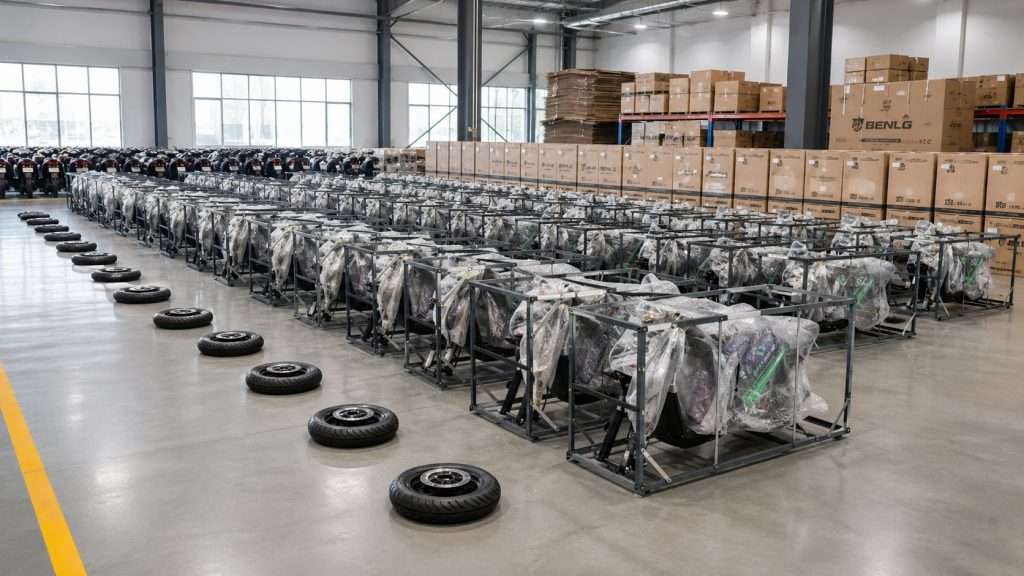
Most of the electric motorcycles on Kenyan roads today are assembled locally from imported kits rather than shipped as finished vehicles. That is not an accident: assembly creates local employment, qualifies for the industrial incentives the policy is built around, and reduces the freight volume per unit because more machines fit in a container.
The trade-off is real. Knocked-down supply requires assembly space, trained hands, quality control and a warranty process — and it moves a share of the risk from the factory to the importer. For a distributor with the capability, that is a reasonable exchange. For a first order, it usually is not: the assembly learning curve costs more than the duty saved, at least until volume justifies it.
What matters either way is that the landed cost comparison is made on the total, including assembly labour if applicable — not on the headline duty rate. We have seen buyers assume a knocked-down shipment automatically attracts a lower rate and build a business case on that assumption. It does not always follow, and the classification question should be settled with a customs broker before the order, not after.
If you are planning across more than one East African market, our analysis of the commercial motorcycle and tricycle market in Africa covers the regional demand picture, and our list of the top electric motorcycle manufacturers in Africa sets out who is already assembling locally. For three-wheelers specifically, there is a separate breakdown of the leading three-wheeler brands in East Africa.
If you are importing rather than buying one
The arithmetic above is what a distributor is really buying. Four numbers decide whether the business works:
- Units per container, for the exact model in the exact packaging. This single figure moves landed cost more than any negotiation on the unit price.
- Landed cost per unit, built from FOB plus freight plus duty and levies plus clearance and inland transport — with the duty basis you have actually confirmed, not the one you assumed.
- The price your dealer can sell at, benchmarked against the retail band in the first table on this page. If your landed cost plus a workable margin lands above that band, the problem is the specification, not the supplier.
- Spare parts as a share of the first order. The fast-moving items — tyres, brake pads, controllers, chargers, battery connectors — priced in from the start rather than discovered in month four.
One structural point worth knowing: the B2B search demand for electric motorcycles in Kenya is thin. Very few buyers in this market search for a Chinese supplier directly, because most supply is arranged through established local assemblers and importers. That does not mean the route is closed — it means enquiries come from relationships and referrals rather than from search, and a supplier who understands that will spend their effort on the right channel.
For the procedural side — documentation, pre-shipment inspection, payment terms — our guide to importing electric bikes, scooters and mopeds from China walks through the sequence in order. We have covered South Africa, Morocco and Rwanda in the same series, and the questions in each are remarkably similar.
Common questions about the price
What is the cheapest electric motorcycle in Kenya?
Used and low-specification imports start around KSh 60,000. Just above that line you are often buying a chassis without the pack — several high-volume brands sell vehicle-only at KSh 90,000–152,000 and charge per swap. A complete machine with one battery runs about KSh 210,000–350,000, and dual-battery versions KSh 380,000–420,000. Below the complete-machine band, battery capacity and motor rating begin to limit how many hours a bike can actually work in a day, which is a false economy if the bike is meant to earn.
Is an electric motorcycle actually cheaper than petrol?
To run, clearly yes — KSh 60–120 per 100 km if you charge at home, or KSh 270–360 on a swap network, against KSh 450–860 for a 150cc petrol machine. Maintenance intervals are about three times longer because there is no oil, spark plug or gearbox to service. The purchase price is higher, though by how much depends on whether the battery is included. Whether the total works comes down to distance: at 80–120 km a day the saving repays the difference quickly; for occasional short trips it may never do so.
Can you charge one at home?
Yes, if there is a socket where the bike is parked. On Kenya Power’s e-mobility tariff, off-peak electricity costs around KSh 8 per kWh, so charging a typical 2–3 kWh pack from empty comes to roughly KSh 16–24. Commercial riders tend to prefer swap networks anyway, because a swap takes minutes rather than hours and a bike sitting on charge is not earning.
Is CKD or CBU better for importing to Kenya?
It depends on volume and capability. CBU is simpler — vehicles arrive ready to sell, with no assembly line, no trained hands and no local quality control to organise. CKD costs less to ship because more units fit in a container, and it usually supports a local-assembly case, but it requires space, labour and a warranty process, and it moves part of the quality risk onto the importer. For a first container, CBU is almost always the right answer; knocked-down supply starts to pay once you are assembling continuously rather than occasionally.
How does the 100,000-unit duty-free quota work?
On 22 May 2026 the government declared the first 100,000 electric vehicles imported into Kenya duty-free, for both public and private use. It is a quota, not a permanent tariff change: the benefit lasts while allocation remains, and how that allocation is administered in practice is a question for KRA and your clearing agent rather than something to infer from the announcement. Build the saving into a quotation only once you have confirmed it applies to your shipment.
Where BENLG fits
We manufacture electric motorcycles, mopeds, bicycles and tricycles in Dongguan, Guangdong, and have done since 2003. Most of the importers and distributors we work with in East Africa are buying one of three things: a private-label programme on a platform they have approved, a mixed first container of two to four models to test a market, or supply in CBU, SKD or CKD form depending on whether they assemble locally. If you are still at the stage of deciding whether to enter the business at all, our guide to starting an electric motorcycle business sets out the commercial model before the pricing questions begin.
On the numbers above, the part we can actually help with is the landed-cost calculation — the units-per-container figure for a specific model and packaging, and what that does to your cost per unit before it reaches Mombasa. That is a more useful conversation to have than a unit price in isolation.
If you are sourcing for Kenya, the most useful thing to send us is the model band you are targeting, the volumes you have in mind, whether you intend to assemble or resell complete units, and the retail band you need to land inside.
📩 Contact the BENLG export team with your Kenya project | 💬 WhatsApp answered during China business hours.
Prices in this article are published dealer and media figures as of 2026 and will move with specification, exchange rates and promotions. Verify against a current quote before committing to a purchase or an import order. Policy references: Finance Bill 2025 (VAT and excise changes), the National Electric Mobility Policy launched 3 February 2026, and the 22 May 2026 declaration on duty-free import of the first 100,000 electric vehicles. Duty treatment and quota allocation should be confirmed with a licensed clearing agent.