For importers and distributors buying directly from a manufacturer: which electric motorcycle parts fail first, how to build a first parts package, and what to demand from your supplier before the container sails.
The question that decides whether an electric two-wheeler business survives its first year is not which controller brand is cheapest. It is which parts are already on the shelf on the day the vehicles start breaking.
For a direct importer, parts are not a product line. They are three things at once — an insurance policy, a service promise, and a cash-flow decision. This guide is about planning that policy before the first container lands, rather than air-freighting a controller six months later at emergency prices.
If you buy from a local or regional distributor rather than importing directly, you may benefit from shorter replenishment times and smaller order quantities — at the cost of less control over price and model selection. That case is covered at the end.
The Parts Map: Four Categories by Service Behaviour
Every electric motorcycle is the same handful of systems. But for stocking purposes the useful sorting is not “motor / battery / controller” — it is how each part behaves in service. Four categories cover the vehicle:
| Category | What is in it | How it behaves in service |
|---|---|---|
| Consumables | Brake pads and shoes, tyres and tubes, brake fluid, fuses, bulbs, mirror glass | Wear on a schedule. High turnover, low unit cost — the bread and butter of a parts shelf |
| Crash and cosmetic | Plastic bodywork, levers, footpegs, stands, lights, glass, seat | Zero demand for months, then a rider drops the bike. Bulky, model-specific, slow-moving — and the reason a two-week repair turns into a two-month wait for one panel |
| Electrical key items | Controller, harness sections, connectors, display, throttle, sensors, charger | Low frequency, high consequence. One controller failure grounds a working vehicle — and electrical items tend to carry the longest lead times, so confirm them early |
| Battery and drive | Battery pack, BMS, hub-motor internals (bearings, Hall sensors), chargers | Long-cycle items, mostly a warranty or lifecycle question. Bearings and sensors are the repairable exceptions |
Two structural facts follow, and they drive everything else in this guide.
Most of the shelf value sits in cheap parts. Consumables and connectors cost little and prevent most of the downtime. A shelf that cannot produce a brake pad is a shelf that fails on a Tuesday.
Most of the downtime risk sits in expensive parts. One controller or harness short can idle a commercial vehicle for weeks if nobody stocked it. A plan that only buys the cheap items fails on the worst day; a plan that only buys the expensive items ties up cash and still runs out of pads.
Which Parts Fail First
Failure rates for electric motorcycle parts vary by market, duty cycle and riding style, so treat any published percentage with suspicion — including ours. What is stable enough to plan from is not a failure ranking but a spending pattern — which categories absorb most of a parts budget on commercial duty:
- Brake pads and tyres. Instant torque and heavy loads chew both faster than on a petrol equivalent. Universal, high-turn, never regretted.
- Connectors and cable sections. Heat, moisture and vibration do their work invisibly. In humid and coastal markets oxidised connectors are a frequent cause of intermittent faults — and they are the cheapest thing on the shelf.
- Throttle assemblies and brake-lever switches. Small moving parts that a working rider touches hundreds of times a day.
- Controllers and harness sections. Infrequent, but every occurrence is a dead vehicle until it is solved.
- Bearings, seals and hub-motor sensors. Wear follows load, water ingress and how the vehicle is washed. These are repairable by a technician; the diagnostic side is covered in our hub motor troubleshooting guide.
Not on the failure list but on the planning list: batteries. Packs age on a calendar as well as on cycle count, and replacement is a fleet-lifecycle decision rather than a spare-part one. The chemistry and total-cost side is covered in our electric moped battery guide.
Building the First-Order Parts Package
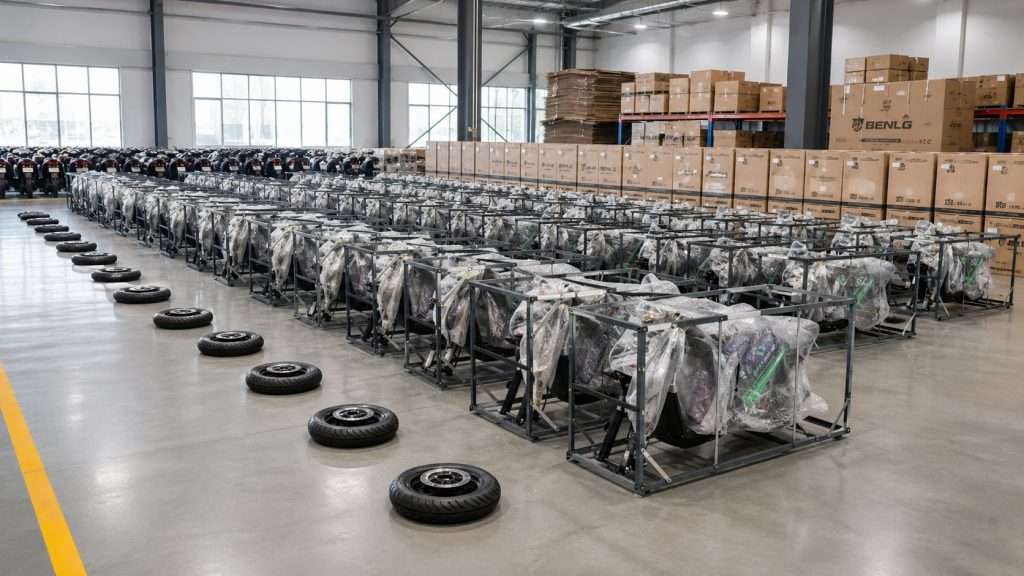
For a first-time importer the common mistake is treating parts as an afterthought and air-freighting them later at emergency prices. The mechanics of a first order work in your favour: parts can usually travel in the same container as the vehicles, mixed in where the loading plan allows. The freight is already paid — a first parts package riding on your vehicle shipment costs a fraction of the same parts as urgent air cargo six months later.
How much to bring is often expressed as a share of the vehicle order value. Some buyers size it as a percentage of the vehicle order value, others build it bottom-up from the list of parts they expect to consume. Either method works if you can defend the number: some suppliers include a starter kit within the order, others quote parts separately and ship them alongside, and the right size depends on fleet size, duty cycle and how much repair your local workshop can actually do. Ask which model applies before you sign — the difference between “included” and “quoted” changes your landed cost.
What scales is the structure, not the percentage:
| Layer | What goes in | Depth | Why |
|---|---|---|---|
| A — order deep | Brake pads and shoes, tyres and tubes, bulbs, fuses, pigtail connectors | What ninety days of use will actually consume | High turnover, low unit cost — these prevent most of the downtime |
| B — order shallow | Mirrors, levers, footpegs, plastics around the steering head and side panels | One or two of each high-breakage item | Slow movers — and the reason a small repair stalls for weeks waiting on one panel |
| C — order at least one | One controller per motor variant, one harness section per model, one display, one charger, one complete hub motor per model family | One each | Expensive per unit — and each one is a vehicle that stays parked without it |
Size the B layer to how the vehicle is used, not to the catalogue: delivery duty breaks different parts than commuter duty, and the plastics a courier scuffs are not the ones a shopper scuffs.
The ratio matters less than the discipline: the first package should let a technician solve the first year’s typical failures without an emergency order. That is the definition of “enough”.
Replenishment: Turning Repair Data into Reorder Points
For operators already running a fleet, the first-order question is replaced by a rhythm question — what reorders when. The tools are basic and underused:
- Log every repair. Part, date, vehicle, mileage or operating hours. A repair log is the only honest forecast of parts demand you will ever have.
- Set a minimum per SKU — the quantity that survives the supplier’s lead time. A minimum that assumes same-week resupply is not a minimum; it is a hope.
- Batch replenishment against the container, not the emergency. If your supplier ships by container, schedule parts reorders with vehicle reorders instead of paying air-freight premiums every quarter.
- Watch dead stock. Crash parts bought generously “just in case” are cash on a shelf. Reorder what moves; rebalance what does not.
A simple starting rule for the fast movers: if you sell or fit roughly ten brake pads a week, and replenishment takes four weeks, your reorder point is not ten — it is forty plus whatever buffer your own discipline requires. The arithmetic is trivial; the discipline of doing it is what separates a parts operation from a cupboard.
Compatibility Traps
Three mistakes account for a large share of wasted parts spending in this business:
- Controller–motor mismatch. Controllers are not generic. Voltage class, phase current limit, connector pinout and firmware parameters have to match the motor. A mismatched pair either fails to drive it or drives it into early failure. Order controllers for your exact motor variant, and label the shelf accordingly.
- Battery format drift. Pack dimensions, connector type and BMS communication must match the vehicle’s battery bay and its controller. Two packs of the same nominal voltage from different series are not interchangeable.
- Model-year changes. Suppliers update plastics, harnesses and connectors between production runs. The parts list you receive with order one may not fit the batch that arrives with order three. Ask for the parts catalogue per batch revision, not per model name.
None of this means you should verify compatibility yourself. It means give your supplier the exact model and version, the part you need, and — where you have it — the original part number or a photo of the failed component, and let them confirm the match. The traps above are the reasons that handover has to be specific, not a homework assignment for the buyer.
What to Demand from Your Supplier
Parts service is a contract item, not a courtesy. Four asks before you commit:
- An itemised parts list with part numbers, per model — the basis of every future order and every warranty claim.
- Lead-time commitments for the key items you actually operate (controller, harness, display), in writing.
- Batch consistency — the same components fitted to the same model across batches, or a documented change note when they differ.
- Parts pricing terms — a price list with a stated validity period, so your after-sales margin is not renegotiated every quarter.
Warranty: What to Ask, Not What to Assume
Warranty in this industry is not one period. It is a schedule per component — a motor, a frame, a controller and a pack rarely carry the same term, and wear items are usually excluded outright. Two disciplines cover it:
- Get the schedule in writing, per component, for the exact model you are quoting. A verbal “two years” that turns out to cover the frame but not the motor is the most expensive kind of misunderstanding.
- Settle how a claim is proved and who pays freight. Many manufacturers accept photo or video evidence and ship the replacement with your next container rather than asking you to send a failed unit back across an ocean. Confirm this before you need it.
On batteries specifically, ask three questions rather than one: what period applies, how capacity loss is assessed, and whether the remedy is a full pack or cells. Battery cover almost always has its own rules and its own measurement method — and “the battery is covered” without a capacity definition is not a warranty you can plan around.
Also separate three situations that get muddled in day-to-day operations: a part bought for routine maintenance, a part needed after accidental damage, and a component claiming warranty service. These are not interchangeable, and treating them as one category is how dealers end up promising cover they cannot deliver.
If You Buy From a Local Distributor Instead
Not every dealer imports. Plenty buy from a regional distributor, and the parts logic changes with it — usually faster to replenish, with less say over price and selection.
| Dimension | Direct import | Local distributor |
|---|---|---|
| Order size | One full container, often mixed models | Units or small batches |
| Lead time | Weeks to months, plus clearance | Days, from stock |
| Unit cost | Factory price, before freight and clearance | Distributor margin on top |
| Model choice | Whatever the factory builds | Whatever the distributor stocks |
| Technical data | From the manufacturer, with the order | Often second-hand, incomplete, or absent |
| Parts | Same container cycle as the vehicles | Off the shelf — limited to what they choose to stock |
Cost deserves more than a unit-price comparison. A factory price looks lower until you add freight, clearance, the cash tied up in a container and the parts you bought in quantities you did not need. A local price looks higher until you net off faster replenishment and less capital sitting on a shelf. Compare landed cost per part consumed, not per part purchased.
What does not change is the four-category structure above. Consumables still turn over fastest, key electrical items still strand a vehicle when missing, and the compatibility traps still apply: a controller bought locally is only useful if it is the variant your motor actually takes.
Two practical consequences. First, calculate reorder points using the lead time of the supplier you actually buy from. A local distributor with reliable stock and short replenishment may let you hold less — but leave room for delays and for items they do not routinely stock. Second, ask a local distributor for the same four things you would ask a manufacturer: an itemised list with part numbers, lead-time commitments, batch consistency, and pricing valid for a stated period. If they cannot produce one, that is a supply risk worth weighing against your other sourcing options — particularly if they are your only source for a model you depend on.
If your business later expands into direct importing, the records and reorder discipline you built on local supply remain useful. You will need to recalculate quantities, lead times, safety stock and landed cost for the new arrangement.
BENLG Parts Support
BENLG (Dongguan Benlg) has manufactured electric two- and three-wheelers since 2003, exporting to more than 65 countries. Our parts policy is built around the planning above:
- Parts for BENLG models, for BENLG customers. We supply after-sales spare parts for our own vehicle range to importers, dealers and fleets who run our vehicles — listed per model, so your shelf maps to your fleet.
- Ship parts with your vehicles. Spare parts can be mixed with complete vehicles in a container order, so a first parts package rides on freight you are already paying rather than on emergency air cargo. Vehicle and parts orders are placed on the same full-container basis.
- Discussed at order stage, not discovered later. Parts requirements and lead times are best settled together with the vehicle order, so your after-sales plan exists before the first rider reports a fault.


On warranty, two components carry the terms importers ask about first: the motor at 24 months, with replacement within the first 12, and the battery pack at 8 months. Every other component carries its own period — ask our team for the current schedule for the model you are quoting.
If you are planning a first order, or reorganising parts support around a fleet you already run, tell us the models, the fleet size and how your workshop is set up, and we will come back with a vehicles-plus-parts proposal rather than a vehicle quotation alone. For the wider procurement sequence — certification, inspection, shipping modes — see the moped scooter sourcing guide and the guide to importing electric bikes, scooters and mopeds from China. Where duty cycles chew through wear parts fastest, the delivery scooter wholesale page covers the commercial configurations.
FAQ
What spare parts should I order with my first container of electric motorcycles?
Structure it in three layers: consumables deep (brake pads, tyres, bulbs, fuses, connectors), crash parts shallow (mirrors, levers, key plastics), and at least one of each key electrical item per variant — one controller per motor variant, one harness per model, one display, one charger. The test is coverage, not quantity: a technician should be able to solve the first year’s typical failures without an emergency order.
How much of my order value should spare parts be?
There is no universal percentage. Some buyers size it as a share of order value, others build it bottom-up from the parts they expect to consume. It scales with fleet size, duty cycle and local repair capability, and suppliers differ on whether a starter set is included in the order or quoted separately. Ask which applies before you sign.
Can electric motorcycle parts be shipped with the vehicles?
Usually yes, and it is the cheapest way to do it — parts can take up space in a container you are already paying for, subject to packaging and loading limits. Confirm packaging, loading feasibility and whether your supplier prices parts inside the vehicle order or as a separate line.
Which electric motorcycle parts fail most often?
On commercial duty, spending concentrates on brake pads and tyres, then connectors and cables, then small moving parts such as throttles and brake-lever switches. Controllers and harnesses fail less often but stop the vehicle when they do. Bearings and hub-motor internals follow load, water exposure and how the vehicle is washed. Exact rates vary by market and use.
How do I avoid ordering parts that do not fit?
Three disciplines: order controllers for your exact motor variant (voltage, current, pinout), keep battery packs to one format per vehicle series, and ask for the parts catalogue per batch revision — suppliers change plastics, harnesses and connectors between runs, and a model name is not a compatibility guarantee.
What warranty terms should an importer confirm before ordering?
The per-component schedule in writing, how a claim is evidenced and who pays freight, and — for batteries — the period, how capacity loss is measured, and whether the remedy is a full pack or cells. Also confirm which wear items are excluded and how accidental damage is handled, so you do not promise cover your supplier will not honour.