


Key takeaways
- Kenya registered 10,478 three-wheelers in 2025, against 4,064 in 2024 — a 158% jump in a single year, in a market where total vehicle registrations rose 1.6%. KNBS Economic Survey 2026, via The Star
- The five tuk tuk brands that matter here: 1) Piaggio Ape, 2) Bajaj RE, 3) TVS King, 4) Atul Gem and Rik, 5) TRÍ in Dar es Salaam. The first three reach buyers through Indian franchises held by two-decade distributors, Atul through regional dealers in a dozen Kenyan towns, TRÍ through lease-to-own in one city.
- Piaggio holds number one in Kenya’s tuk tuk segment through Car & General, its exclusive distributor since 2002.
- Bajaj is the largest three-wheeler maker by volume: 668,657 units in FY2025, including 189,221 exported.
- Atul is the one to watch among second-tier Indian brands — twelve Kenyan towns sell and service its vehicles, and its parent has named East Africa as an FY27 priority.
- Kiri EV is the local-assembly story: it imports Chinese CKD kits, assembles in Nairobi, and sells charging and battery swapping alongside the vehicle.
- Electric became a factory offer rather than a conversion in 2024–2026 — Piaggio’s E-City and E-Xtra FX Max landed in Nairobi and Mombasa in February 2024; Skoot’s battery-swapping e3W followed in February 2026.
- Rwanda still waives import duty, excise and VAT on electric vehicles, a concession that runs to 30 June 2028. Rwanda tax measures, via State Taxation Administration
Africa’s electric three-wheeler market in 2026
Three-wheelers — tuk tuks in the local vocabulary — carry passengers, parcels and produce across Kenya, Uganda, Tanzania and Rwanda. The vehicles are imported, almost entirely from India and China, and the businesses that sell them are built on distribution rather than advertising: a franchise, a parts pipeline, and a mechanic in every county town.
What changed in the last two years is the fuel. Diesel and petrol prices in the region move with the shilling and with freight, and an operator’s daily margin is thin enough that a fuel spike wipes it out. That is the commercial reason electric three-wheelers moved from pilot projects into factory catalogues — not emissions policy, and not novelty.
Hard numbers are still scarce. Kenya is the one market in the region that publishes registrations by vehicle class every year, and that series shows how fast the category is moving.
Kenya
Kenya’s Economic Survey 2026 records 10,478 new three-wheelers registered in 2025, against 4,064 in 2024 — a 158% increase in a single year, in a period when total new vehicle registrations rose 1.6%. Motorcycles and auto-cycles, at 241,763 units, grew faster still, which tells you where the delivery economy is heading. The survey puts three-wheeler registrations at 10,478 for 2025
Distribution explains the shape of the market. Car & General, which began in Nakuru in 1936, was the first company in Kenya to put three-wheelers on the road as taxis more than twenty years ago, and it still runs the widest branch network in the category. Car & General launched Kenya’s first tuk tuk taxis In 2025 it extended that network to Kitui through a dealer, covering eastern counties that previously bought from Nairobi. the Kitui dealership opened in 2025
Uganda
Uganda’s growth is concentrated in Kampala, where two- and three-wheelers do most of the passenger work. The government has paired tax incentives with a national electric mobility strategy, and fleet operators have been testing electric three-wheelers on both passenger and cargo routes. Uganda’s national electric mobility strategy The constraint is the same as everywhere in the region: charging follows fleet depots, not the other way round.
Tanzania
Tanzania is one of the region’s largest three-wheeler markets and its least documented. UNEP counts 1.2 million combustion two- and three-wheelers on the country’s roads, with more than 500,000 three-wheelers already in service, and at least ten e-mobility companies have entered to sell electric replacements against them.
The number that decides a purchase is the fuel bill. UNEP’s reporting puts a 20km run at about $1.20 on petrol against $0.20 on electricity — a sixth of the cost — which is why a lease-to-own scheme can price a vehicle at a daily rate that undercuts the pump rather than the showroom.
Dar es Salaam is where that arithmetic is being tested. TRÍ, registered as ZioTio, has operated in Tanzania since 2020 and is unusually well documented for a company its size: 33 customers on lease-to-own or retail terms by October 2023, a pilot with Bolt and Watu covering 25 electric bajaj taxis, and a stated ambition of 500 vehicles in Dar es Salaam by the end of 2024 — a target rather than a result.
Charging is the part importers underestimate. TRÍ was selected by DART, the city’s bus rapid transit authority, to install and operate four charging stations at or near BRT stations, with a further charger at the Dar es Salaam Institute of Technology — placed where drivers already queue, not where land was cheap.
Import duty still applies to the category, and the incentive structure has been less generous than Rwanda’s, which is why the national fleet remains overwhelmingly petrol, CNG and diesel. That is the opening rather than the obstacle: a market of 1.2 million vehicles served by a handful of electric suppliers is a different proposition from one where the incumbents have already converted.
Rwanda
Rwanda is the region’s policy outlier. Electric vehicles, batteries and charging equipment enter free of import duty, excise duty and VAT, a concession that runs to 30 June 2028. electric vehicles and charging equipment are exempt from import duty, excise and VAT until 30 June 2028 The same reform package reinstated VAT on hybrid cars from July 2025 and added a consumption tax on them, which separates battery-electric from hybrid in the buyer’s cost calculation.
Kigali has also gone further on two-wheelers than any other capital in the region, restricting new public-transport motorcycle registrations to electric models. Three-wheelers have followed the same direction, and battery-swapping operators built their first East African networks there.
What changed between 2024 and 2026
Three developments moved electric three-wheelers from demonstration to catalogue:
- Factory electric models. Piaggio and Car & General launched the Ape E-City FX Max and E-Xtra FX Max in Nairobi and Mombasa in February 2024, followed by a 30-station charging partnership on the coast. the Ape E-City FX Max and E-Xtra FX Max launched in February 2024
- Battery swapping as a product. Skoot Technology and SUN Mobility launched the Skoot e3W in Nairobi in February 2026 — SUN Mobility’s first deployment in Africa — with Car & General providing distribution and service after two years of road testing. Skoot e3W launched in Nairobi in February 2026
- Supply from India doubled. Indian three-wheeler exports reached 50,655 units in April 2026, nearly double the same month a year earlier, which is the supply side of the same story. SIAM data, reported in May 2026
Kenya’s target of 10,000 public charging points by 2030 sits behind all three. Kenya’s 10,000 charging-point plan Charging coverage, not vehicle supply, is what will decide which counties electrify first.
Top 5 tuk tuk brands in East Africa
These five tuk tuk brands are ranked on units in service and service reach — how many machines are on the road, and how easily an operator can get a part — because that is what decides resale value and uptime. Where a manufacturer publishes unit volumes, the figure is cited. Where it does not, the rank rests on documented distribution rather than an estimate, and the entry says so.
Why BENLG is not on this list. This ranking covers brands sold to the operator — the badge a driver in Nairobi or Kampala sees on the street. BENLG builds three-wheelers for other companies’ brands: the vehicles leave the factory carrying a customer’s badge and sell through that customer’s network. BENLG sits one layer upstream, in OEM and ODM supply, complete units, SKD and CKD kits.
The same applies to the Chinese factories you will meet while sourcing — Jinpeng, Zongshen, Loncin, Dayang. They supply the brands on this list and the importers building new ones, which is why they are covered further down rather than ranked here.
1. Piaggio (Ape)
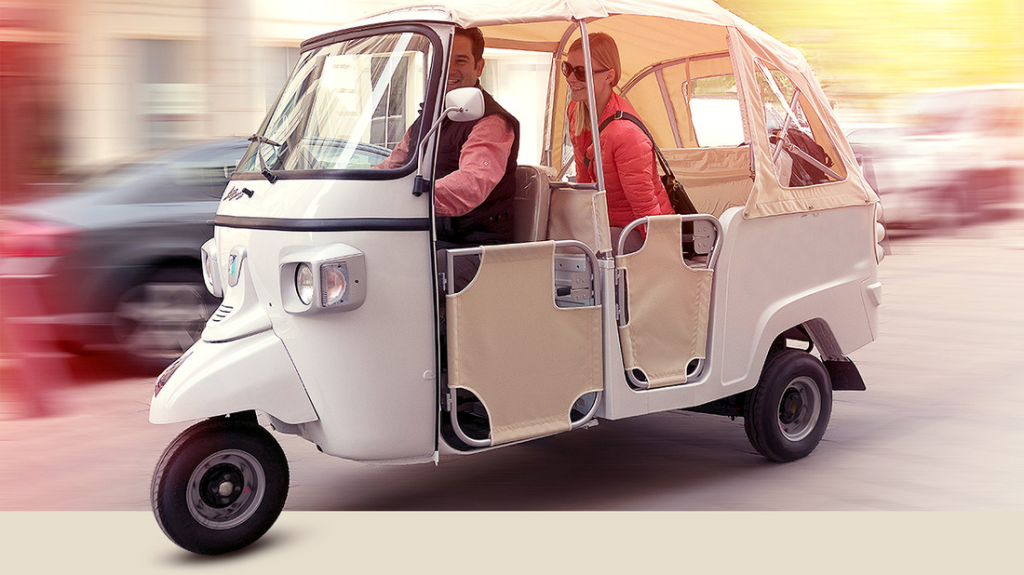
What puts it at number one: the Ape franchise holds the number one position in Kenya’s tuk tuk segment, distributed exclusively by Car & General since 2002. Piaggio’s Ape franchise, distributed exclusively by Car & General since 2002, holds the number one position Two decades of single-distributor continuity is why the parts pipeline reaches county towns where no other brand has a counter.
What it sells: petrol 200–230cc passenger models, a 435cc diesel cargo platform, and the factory electric E-City FX Max and E-Xtra FX Max. the Ape range spans 200–230cc petrol, a 435cc diesel cargo platform and two factory electric models In 2025 Car & General added an LPG variant, the Ape NXT+, which the company says cuts fuel cost by around 30% against petrol — a claim worth testing against your own duty cycle rather than taking at face value. Car & General’s own figure for the Ape NXT+
What it means for you: entering Kenya as a distributor means competing with a franchise that has held the ground since before most of today’s importers existed. In Uganda, Tanzania or Rwanda Piaggio is present, but the gap is narrower.
2. Bajaj (RE, Maxima)
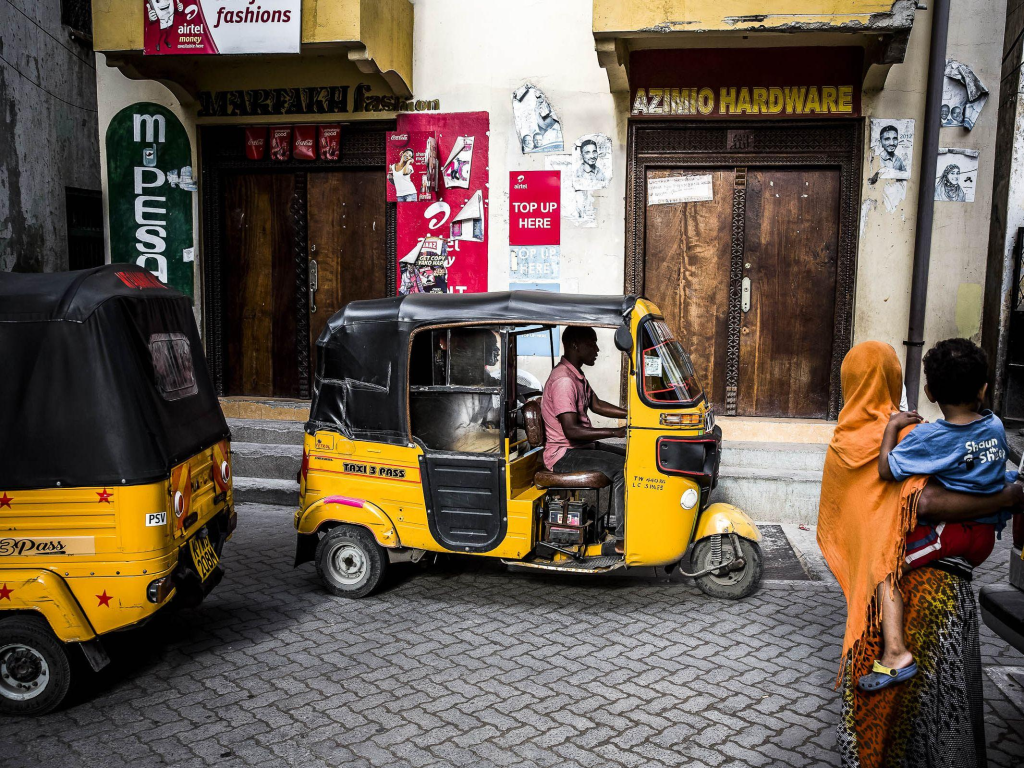
What puts it at number two: scale. Bajaj built 668,657 three-wheelers in FY2025, 7.3% more than the year before, of which 189,221 were exported — a 19% increase in export volume in a year when its home market softened. Bajaj Auto annual report, FY2024-25 In India the RE platform holds 75.7% of the domestic internal-combustion three-wheeler market, the volume base that pays for the parts network.
What it sells: the RE and Maxima passenger platforms in petrol, CNG and diesel, with electric three-wheelers still concentrated in India rather than exported at scale.
What it means for you: Bajaj’s advantage in East Africa is not price, it is aftermarket depth. Any competitor has to answer the question an operator actually asks: can I get this part in Mombasa on a Tuesday?
3. TVS (King)

What puts it at number three: TVS is the third of the Indian franchises that structure this market, and in Kenya its King platform is sold through the same Car & General branch network that carries Piaggio — so a buyer can compare the two in one showroom and have either serviced by the same technicians. Car & General’s branches sell both Piaggio three-wheelers and TVS motorcycles
What it sells: the King range in petrol, diesel and CNG, plus electric three-wheelers deployed mainly through fleet partnerships rather than open retail.
What it means for you: TVS does not break out three-wheeler volumes by African market, so its rank rests on network access rather than a published number. Treat it as the third incumbent, not as a distant fourth.
4. Atul (Gem, Rik)

What puts it at number four: the reach of a second-tier brand that did the unglamorous work. Atul is not in the same weight class as Bajaj and does not pretend to be: it sells into more than 27 countries, and exports rose 70% in FY26 across 31 markets, with East Africa named as a priority for FY27. In Kenya that export push shows up as something concrete — the Kenyan distributor lists twelve towns where Atul three-wheelers are sold and serviced: Nakuru, Kisumu, Kakamega, Mtwapa, Kilifi, Malindi, Siaya, Bungoma, Thika, Ukunda, Ruiru and Nairobi itself. Those are not showrooms in a capital; they are towns where a broken vehicle gets fixed.
What it sells: the Gem passenger and cargo platforms and the Rik passenger range, in diesel, petrol, CNG, LPG and electric — a range that covers all five fuel types, a spread that matters in a region where one country subsidises CNG and its neighbour does not.
What it means for you: Atul is the proof that dealer coverage can be built without a twenty-year franchise. It also sets the bar a new brand has to clear in the second and third tier of towns, where the incumbents’ vans do not always reach.
5. TRÍ (E1, E2)

What puts it at number five: it is the only entry here whose deployment figures were checked by someone other than its own marketing. Under the EU-funded SOLUTIONSplus programme 20 E1 vehicles and five of the iterated E2 went onto Dar es Salaam’s roads, and the city’s BRT authority chose the company to install and operate four charging stations at or near BRT stations — a public contract, not a press release. Those numbers sit alongside 33 customers on lease-to-own or retail terms by October 2023 and a pilot with Bolt and Watu covering 25 electric bajaj taxis.
What it sells: the E1 and E2 electric bajaj for passenger work, sold mostly on a B2C lease-to-own basis rather than for cash — the mechanism that lets a driver with no capital end up owning the vehicle. According to UNEP, the second-generation model charges in 2.5 hours and returns 115km.
What it means for you: TRÍ is small, and honest reporting of it should say so. Even at its stated target of 500 vehicles it would be 0.1% of the 500,000 three-wheelers already in service, and its presence is Dar es Salaam rather than East Africa. What earns it a place is the commercial model: more than $1 million in revenue in 16 months, on a lease-to-own scheme, with demand running at roughly three times what it can supply. For an importer, that is the case for financing the buyer instead of discounting the vehicle.
Also worth tracking
Kiri EV in Nairobi is the clearest Kenyan example of the assembly route: its first batch of cargo three-wheelers was assembled in Nairobi from Chinese CKD kits. It also sells charging and swapping alongside the vehicle. What it lacks is published deployment figures, which is why TRÍ and not Kiri holds fifth place.
Mahindra’s Last Mile Mobility division builds the Treo, Zor and e-Alfa ranges and sells electric three-wheelers across a wide African footprint, but its export volumes are still thin — Mahindra exported 138 Treo units in September 2026, against roughly 9,000 sold at home that month. Skoot’s e3W, launched in Nairobi in February 2026 with SUN Mobility swapping and Car & General service, is the first serious attempt to sell a tuk tuk as a subscription rather than a vehicle. Omega Seiki is working from Dubai — its Dubai assembly plant serves the Middle East and Africa — and has signalled East Africa as a target without a retail network there yet. All three are worth watching; none has the installed base to enter the ranking today.
The supplier tier behind these brands
Search for tuk tuk suppliers and a different set of names appears: Jinpeng and Zongshen from Jiangsu and Chongqing, Loncin, Luoyang Dayang. These are factories, not retail brands. They supply the vehicles that carry someone else’s badge, and they appear in market research as suppliers rather than competitors — which is exactly the layer where an importer building a new brand operates.
That is also why they are not ranked above. A ranking measures what an operator sees on the street; a supplier list measures who can build a vehicle to a specification. Mixing the two produces a list that answers neither question. The guide to Chinese electric tricycle and motorcycle manufacturers covers how to tell those suppliers apart.
What this means for importers and distributors
The five tuk tuk brands above describe a market where distribution, not product, decides who survives. Three things follow from that.
First, the entry cost is a parts pipeline, not a container. An operator buys a vehicle once and buys parts for eight years. A distributor who cannot supply a brake shoe in a county town loses the next sale to the one who can, which is why incumbents’ dealer coverage, not their price list, is the real barrier.
Second, electric changes the calculation without changing the rule. A factory electric Ape or a swap-model e3W removes fuel from the operator’s daily cost, but adds a dependency on charging or swapping coverage that the distributor now has to guarantee. Selling an electric tuk tuk without a charging answer is selling a vehicle the buyer cannot use.
Third, the private-label route is the realistic entry for a new brand. Taking a franchise from Piaggio, Bajaj or TVS is possible in principle and rare in practice. Building your own badge on a Chinese platform — specifying battery, motor, body and warranty terms — is how most new distributors have entered the category in the past five years.
Why fuel cost, not emissions policy, is driving the switch
An operator running a tuk tuk in Nairobi or Dar es Salaam makes the purchase decision on one number: what the vehicle costs per kilometre, including fuel, finance and repairs. Fuel is the largest and least predictable of the three. When the shilling weakens against the dollar, the pump price follows within weeks, while fares move slowly and grudgingly.
That is why the first electric three-wheelers to find buyers were not sold on environmental grounds. They were sold as a fixed energy cost. A swap subscription or a depot charge converts an unpredictable daily expense into a predictable one, which is worth more to an owner-driver than a lower average price with volatility attached.
The same logic explains Piaggio’s LPG variant. Car & General puts the fuel saving at around 30% against petrol, and the constraint is not the vehicle but the refilling network, which is concentrated in Nairobi, Mombasa and Nakuru. Car & General’s own figure for the Ape NXT+ Different fuel, same rule: the infrastructure decides whether the saving is real.
For a distributor, the practical test before importing any electric three-wheeler is whether you can answer three questions on the buyer’s behalf — where the vehicle charges, who services the battery, and what happens to resale value in five years. A supplier who cannot help you answer those has not finished the product.
Why importers go direct to Chinese factories
East Africa’s electric three-wheeler market runs on two supply routes. One is the franchise: an Indian or global brand appoints a national distributor, sets the price, and controls the specification. The other is direct: an importer contracts a Chinese factory, chooses the battery chemistry, motor rating, body configuration and badge, and becomes the brand.
The franchise route buys certainty — a proven vehicle, an existing parts catalogue, a name operators recognise. It also buys a ceiling: you cannot differentiate on product, you compete on price and service within a specification someone else set.
The direct route buys control. It suits importers who already know their market — the routes, the loads, the road surfaces, the price point that sells — and who want a vehicle built for those conditions rather than adapted to them. It requires more engineering attention up front: battery capacity sized to the real daily distance, a motor rated for continuous rather than peak load, a frame spec that matches the payload the vehicle will actually carry.
Most new brands in the region have taken the second route in the past five years, and the reason is arithmetic rather than ideology. A factory that builds to your specification will also build the spare-parts kit, the packaging and the documentation that go with it, which is what makes a new badge survivable in the second year.
Where to source three-wheelers for East Africa
Sourcing splits into two decisions that buyers usually conflate: which factory, and which supply model.
The factory. China’s electric tricycle cluster sits in Jiangsu and Chongqing, and the difference between suppliers is less about price than about whether they will build to your specification and stand behind it in writing. The sourcing guide for Chinese tricycle manufacturers sets out what to ask before a first order.
The supply model. Complete units (CBU) arrive ready to sell and carry the highest duty and freight per vehicle. Semi-knocked-down (SKD) and completely-knocked-down (CKD) kits cut landed cost and can qualify for local assembly incentives, at the price of an assembly line, trained staff and a longer first shipment. The moped and three-wheeler sourcing guide covers the trade-offs in detail.
The paperwork. Lithium cells shipped as dangerous goods fall under transport rules that vary by carrier and by port, and the certificate that satisfies one customs authority often does not satisfy another. Confirm the exact document your registration authority accepts before the container leaves, not after it lands.
What BENLG brings to a brand of your own
BENLG has built electric two- and three-wheelers in Dongguan since 2003, and builds no petrol vehicles at all. That single fact explains why a factory appears at the end of an article about brands: every engineering hour goes into battery, motor, controller and frame rather than into keeping a fuel platform alive alongside them. If the tuk tuk brands above show what a franchise looks like from the outside, this section is what the upstream layer looks like when you are the one holding the badge.
Three product lines cover the work an East African importer usually asks for.
Passenger three-wheelers
Three to five seats, sized for urban routes and for the county roads where a matatu cannot go. Body configuration, seat layout, battery chemistry and motor rating are all set at order time rather than chosen from a fixed catalogue — which is the difference between importing a vehicle and importing a product for your market.

Cargo three-wheelers
Box body, flatbed and pickup configurations for last-mile delivery, water and gas distribution, and agricultural collection. Payload and deck length are specified against the load the operator will actually carry, because an under-specified frame is the failure that shows up in month fourteen, not month one.

Electric motorcycles
For boda boda passenger work and courier fleets — the same drivetrain engineering in a two-wheel package, which matters when a distributor wants one supplier for both halves of the business.

Ride comfort on broken surfaces
On a rigid-axle three-wheeler, a pothole under one rear wheel is transmitted to every passenger in the cabin; the two sides are mechanically tied together. BENLG offers independent rear suspension as an option on its passenger models, so each rear wheel absorbs its own road. On tarmac the difference is small. On the surfaces most East African passenger routes actually run on, it is the difference between a driver keeping his regulars and losing them to a competitor. The video below shows the system on a passenger model.
What the ranking above implies for a new brand
Each of the five entries earns its place for a reason that a new brand has to replicate. Read as a checklist rather than a scoreboard:
| What the ranking shows | What it costs you to copy | What BENLG supplies for it |
|---|---|---|
| Piaggio’s edge is a distributor that has held the franchise since 2002 | Time you do not have — a dealer network is built town by town | A vehicle specified for your price point, so the network you build has something to sell |
| Bajaj’s edge is parts depth at national scale | Working capital tied up in stock before the first sale | A spare-parts kit shipped with the first order, matched to the models in it |
| Atul’s edge is service points outside the capital | Training technicians you did not hire | Assembly and service documentation, remote troubleshooting, factory training visits |
| TRÍ’s edge is lease-to-own, not a lower sticker price | Capital you lend out, and a collections process behind it | A specification and volume plan a local financier can underwrite, plus SKD and CKD kits |
Four supply models, one factory
- Complete units (CBU) — assembled, tested and shipped ready to sell. Fastest to market, highest freight and duty per vehicle.
- SKD kits — major assemblies separated for lower landed cost, with a short assembly step at your end.
- CKD kits — the full knocked-down route, for importers who want local assembly content and the duty treatment that comes with it.
- OEM and ODM — your badge, your colours, your specification, including body and frame changes where volume supports them.
What travels with the vehicle matters as much as the vehicle: a spare-parts kit sized to the order, assembly documentation, remote technical support during the first build, and factory visits in Guangdong for your engineers before the first container is confirmed. That is the package a new brand needs in year one, when a single unresolved fault at a customer site costs more than the part.
If charging rather than the vehicle is your open question, the three-layer model for cutting fuel costs in Africa covers swapping cabinets and solar plus storage as a package rather than as separate purchases.
See the electric tricycle range · Talk to us about an OEM programme


