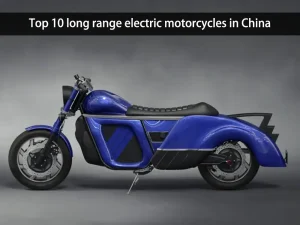
2026 Update: China's Motorcycle Industry in Numbers
This section brings together the latest official data from the China Chamber of Commerce for Motorcycles (CCCM), covering the whole of 2025 and the first half of 2026. It shows how the manufacturers covered on this page are performing right now, and it supersedes any figure you find further down. Everything below this update is the original article, and we explain at the end of this section why we have kept it.
The first half of 2026 at a glance
China's motorcycle industry kept growing in the first six months of 2026, but the composition of that growth matters as much as the headline number, especially if it is being used as a buying signal.
| Indicator (January–June 2026) | Volume | Change vs 2025 |
|---|
| Total motorcycle production | 12.085 million units | +12.68% |
| Total motorcycle sales | 12.0685 million units | +12.53% |
| Fuel motorcycle sales | 10.1724 million units | +12.44% |
| Electric motorcycle sales | 1.8961 million units | +13.04% |
| Complete-vehicle exports | 7.5699 million units | +17.00% |
| Export value, complete vehicles | USD 5.175 billion | +21.03% |
| Export value, all motorcycle products | USD 6.575 billion | +23.99% |
| Fuel motorcycles sold inside China | 2.6496 million units | +2.09% |
Two things stand out. First, exports are doing the heavy lifting, growing roughly six times faster than the domestic market. Second, domestic demand has only just started to recover: sales of fuel motorcycles inside China rose 2.09%, after falling 6.18% across the whole of 2025. By July 2026 the cumulative picture had changed little, with production and sales reaching 14.355 million and 14.2897 million units, up 13.84% and 13.27%, while complete-vehicle exports climbed 18.02% to 8.9895 million units.
The 2026 first-half sales ranking, and who moved
The table below sets the CCCM's official ranking of fuel-motorcycle sales by group for January–June 2026 against each group's position in the full-year 2025 list.
| 2026 H1 rank | Manufacturer | H1 2026 sales (units) | Share | 2025 full-year rank | Movement |
|---|
| 1 | Dachangjiang Group (Haojue) | 1,536,800 | 15.1% | 1 | held |
| 2 | Loncin | 730,800 | 7.2% | 2 | held |
| 3 | Guangdong Daye (Zontes) | 725,600 | 7.1% | 4 | up 1 |
| 4 | Zongshen | 660,200 | 6.5% | 3 | down 1 |
| 5 | Chongqing Yinxiang | 602,800 | 5.9% | 7 | up 2 |
| 6 | Sundiro Honda | 534,800 | 5.3% | 5 | down 1 |
| 7 | Guangzhou Haojin | 426,800 | 4.2% | 6 | down 1 |
| 8 | Luoyang Beifang (Dayang) | 343,900 | 3.4% | 8 | held |
| 9 | Wuyang-Honda | 339,000 | 3.3% | 9 | held |
| 10 | Jiangmen Zhufeng | 272,700 | 2.7% | 10 | held |
Together the top ten groups sold 6.1733 million fuel motorcycles, or 60.69% of the category. That level of concentration has barely changed in a decade. What has changed is the order behind the leader: Guangdong Daye (Zontes) moved ahead of Zongshen, and Chongqing Yinxiang jumped two places into fifth, both on the strength of export demand rather than the domestic market.
The export leaders are a different list
Because exports now drive the industry, the export rankings are more useful to importers than the overall sales ranking, and they look different.
By export volume in the first half of 2026, the ten leading groups were Dachangjiang, Loncin, Guangdong Daye, Chongqing Yinxiang, Guangzhou Haojin, Zongshen, Sundiro Honda, Jiangmen Zhufeng, Qianli Technology and Guangzhou Tianma, shipping 4.6656 million units, or 61.63% of all exports.
By export value the list changes: Dachangjiang, Loncin, Guangdong Daye, Chongqing Yinxiang, Sundiro Honda, Zongshen, CFMOTO, Guangzhou Haojin, Qianjiang and Xiamen Xiaxing accounted for USD 3.342 billion, or 64.6% of export value. CFMOTO and Qianjiang appear here but not in the volume top ten: they export fewer motorcycles at considerably higher prices, which is exactly the positioning that gives them better margins.
Where the motorcycles are going
Africa became China's largest motorcycle export market in the first half of 2026. Shipments reached 3.8314 million units worth USD 2.097 billion, up 43.79% in volume and 50.33% in value year on year. Latin America grew a more modest 6.4%, while Myanmar rose 255% and Malaysia 166%.
For distributors in emerging markets the implication is straightforward. Africa is where Chinese manufacturers are concentrating capacity, homologation effort and spare-parts logistics right now, and it is also where competition between suppliers is sharpest. Latin America remains a large but slower-growing market, and the two-wheeler leaders there are already well entrenched.
A volume business with a price problem
There is a structural weakness behind the headline growth. Basic commuter displacements, the 100–125cc and 125–150cc bands, accounted for close to 70% of China's motorcycle export volume in the first half of 2026, and the average export price of a complete motorcycle was about USD 660 against a global average of more than USD 1,100.
The CCCM's own secretary-general, Zhang Hongbo, summarised the gap bluntly in August 2026: China accounts for more than 70% of global motorcycle trade volume but only around 35% of its revenue. The displacement breakdown shows where the volume actually sits: the 125cc series shipped 2.4262 million units (+16.76%), the 150cc series 1.9676 million (+5.95%), the 110cc series 1.1342 million (+53.76%), the 200cc series 717,000 (+13.05%) and the 250cc series 273,900 (+50.67%), while the smallest 50cc series fell 23.47%.
This is not a reason to avoid Chinese suppliers. It is a reason to negotiate on specification rather than on unit price alone. The same factories that ship USD 600 commuters also build the mid-displacement models that European distributors sell for four times that amount.
Revenue is growing faster than profit
Anyone assessing a supplier's stability should look past unit volume. In the first five months of 2026, China's motorcycle manufacturers recorded revenue of RMB 70.295 billion, up 10.05%, but total profit of RMB 4.844 billion, down 1.68%. Financial expenses rose 608.94%, and accounts receivable reached RMB 28.596 billion, up 11.83%.
At the level of the 83 largest manufacturers, first-half 2026 revenue was RMB 87.54 billion, up 12.29%, while profit growth was 9.25%, again behind revenue. In other words, the industry is selling more motorcycles for proportionally less money, and that price pressure is being absorbed across the supply chain. It is worth weighing when comparing quotations that look unusually low.
The large-displacement boom is entering a mature phase
The premium end of the market told the industry's best story in 2025, when the 500–800cc segment grew 128.7% and the above-800cc segment 70.5%, both far above the industry average. That phase is now easing. In the first seven months of 2026, growth above 250cc slowed to about 2%, and for the first half of the year the segment sold 506,400 units, up just 0.88% from a year earlier, while production fell 1.5%.
The CCCM's reading is that this reflects a change in the basis of competition rather than collapsing demand: from a displacement arms race to a contest over quality, durability, finish, service and resale value. For importers, that shift favours manufacturers with genuine engineering depth — CFMOTO, QJMOTOR, VOGE, Zontes and Kove, with ZXMoto now fielding the 820X and its 819cc three-cylinder — over those that simply fitted a larger engine into an existing chassis.
Electric motorcycles are a separate leaderboard
Electrification has its own ranking, and it is far more concentrated than the fuel market: the top ten electric-motorcycle makers accounted for 93.2% of the 1.8961 million units sold in the first half of 2026.
| 2026 H1 rank | Electric-motorcycle maker | H1 2026 sales (units) |
|---|
| 1 | Zhejiang Luyuan | 388,800 |
| 2 | Yadea Group | 331,100 |
| 3 | CFMOTO (ZEEHO) | 303,300 |
| 4 | Jiangsu Xinri | 207,400 |
| 5 | Zongshen | 205,400 |
| 6 | Jiangsu Huaihai | 150,900 |
| 7 | Bus New Energy | 70,700 |
| 8 | Wuxing Vehicles | 44,200 |
| 9 | Jinyi | 34,500 |
| 10 | Jiangsu Zhongxing | 30,800 |
Two points stand out. Luyuan overtook Yadea to lead the segment, growing 72.65% and lifting its share to 20.5%. And Zongshen, fourth in the fuel ranking, is also the fifth-largest electric-motorcycle maker, the clearest evidence that the traditional fuel giants are no longer ignoring electrification.
The ten leading manufacturers in 2026
— 1,536,800 units in the first half of 2026, 15.1% of the market and first place for both export volume and export value. Haojue remains the benchmark for high-volume commuter manufacturing, and its Suzuki joint venture gives it access to proven mid-displacement platforms. In 2026 it introduced a variable-valve-lift (VVL) engine on the UFR150, with a GSX250R update to follow, and it continues to build its range of sportbikes, street bikes, off-road models and electric scooters. For distributors who need predictable volume, nationwide parts support and a brand customers already recognise, Haojue is hard to displace.
— 730,800 units in the first half of 2026 and second place by both export volume and export value. Loncin's premium arm, VOGE, has become the group's growth engine: it passed 70,000 domestic sales and now operates 1,165 overseas outlets, close to 900 of them in Europe. Its 2026 range runs from the DS800 Rally and the DS900X adventure bikes to the SR4 GT maxi-scooter and the SR450X, which reached Spanish dealers in September 2026 at €6,288 with a five-year warranty. The group also fired up China's first GDI direct-injection motorcycle engine in March 2026, and it sold 66,900 electric motorcycles in 2025. Its industrial range — engines, generators, drones and new-energy vehicles — gives it resources few rivals can match.
— 725,600 units, up from fourth to third, and now third in both export volume and export value. Zontes is the clearest example of a Chinese manufacturer winning on technology rather than price: its ZT703-F and ZT703-T triple-cylinder adventure models reached European dealers in 2026 at around €9,000, carrying ride-by-wire, a six-axis IMU, cornering ABS, radar-assisted features and cruise control. The 368G and 150X scooters extend the same approach into the mid-displacement scooter market that Honda and Yamaha have long owned.
— 660,200 units, slipping from third to fourth, but sixth by export volume and export value. Zongshen is the most electrified of the traditional fuel giants: it sold 465,100 electric motorcycles in 2025 and ranked fifth in the 2026 first-half electric ranking with 205,400 units, alongside its Cyclone leisure brand and CVT automatic-transmission models. Its three-brand structure, spread across commuter, leisure and electric lines, makes it a flexible partner for markets at different stages of electrification.
— 602,800 units, jumping two places into fifth, and fourth by both export volume and export value. Almost all of Yinxiang's output is exported, which makes it one of the most price-competitive volume suppliers for Africa, Southeast Asia and Latin America. It has no significant electric programme, so it suits buyers who need rugged, cost-focused commuter models rather than an electrification roadmap.
— 534,800 units, sixth by volume and fifth by export value. A Honda joint venture with plants in Taicang and Tianjin, Sundiro Honda combines Honda's model pipeline and quality system with local manufacturing cost, and it exports to more than 50 countries. For importers who need Japanese engineering standards at Chinese cost, it sits in a category of its own.
— 426,800 units, seventh, and fifth by export volume. Haojin is a specialist in export-led commuter production with limited electric activity. It is the kind of supplier that competes on specification-per-dollar and on the reliability of repeat container shipments rather than on brand equity.
— 343,900 units, eighth, and outside the top ten exporters. Dayang's distinguishing technology is its hybrid scooter range, which uses stop-start systems in the 150–350cc band, and it has been shifting more attention toward three-wheelers alongside its ADV and retro models. It suits buyers with mixed two- and three-wheeler requirements.
— 339,000 units, ninth, and outside the top ten exporters. Founded in 1992, Wuyang-Honda is the older of the two Honda joint ventures, with roughly 7,000 sales and service outlets inside China and exports to about 70 countries. Its strength is the combination of a premium domestic service network and Honda-backed product reliability.
— 272,700 units, tenth, and eighth by export volume. Zhufeng is a volume exporter with limited electric activity, and it rounds out the group of Guangdong-based manufacturers that have built their business around overseas container programmes rather than domestic retail.
The other manufacturers on this page in 2026
— outside the fuel top ten by volume, but ninth by export value, which tells you where its business sits. Qianjiang, part of Geely, runs a dual-brand strategy with QJMOTOR for mid- to large-displacement models, Benelli — long the best-selling imported brand in Italy — and Keeway for entry-level and commuter markets. Its 2026 line-up spans 400–800cc sport bikes, cruisers, ADVs and scooters, including the SRT 700, and it has been expanding into ATV/UTV and electric two-wheelers.
— outside the fuel top ten by volume but seventh by export value, and third in the electric-motorcycle ranking through ZEEHO, which sold about 550,000 units in 2025 and is targeting one million in 2026. CFMOTO's value comes from positioning rather than volume: a Moto2 and Moto3 racing programme, the 450MT and 1000MT-X adventure models, a range that reaches 1,000cc, and overseas plants in Mexico and Thailand. It is the Chinese brand most often compared directly with established European and Japanese premium makers.
— outside the fuel top ten but ninth by export volume, with roughly 440,000 units in 2025 and about 92% of them exported, mainly to Mexico, Panama and other emerging markets. The parent rebranded as Qianli Technology in 2025 and continues to invest in lithium-battery motorcycle development alongside its established commuter and cruiser range.
— about 428,100 units in 2025, down 7.9%, with limited export data. Dayun's appeal is breadth rather than scale: motorcycles, commercial vehicles and light three-wheelers under one platform, which lets a distributor consolidate several product categories behind a single supplier relationship.
What this means for importers
- Judge suppliers on export capability, not domestic volume. The domestic market grew 2.09% in the first half of 2026 while exports grew 17%. A manufacturer that is strong at home is not automatically strong in your market.
- Africa is where capacity and support are concentrating. First-half shipments there rose 43.79% in volume and 50.33% in value. Distributors in Africa and adjacent markets will find the widest supplier choice and the fastest lead times.
- Expect to negotiate on specification, not just price. With export volumes dominated by 100–150cc commuters and an average export price of about USD 660, suppliers have limited room on price but considerable room on specification, warranty and parts commitments.
- Treat large-displacement growth as normalising. After 128.7% growth in the 500–800cc band in 2025, growth above 250cc slowed to about 2% in the first seven months of 2026. Premium models still sell, but they now compete on quality and after-sales rather than novelty.
- Check the financial health behind the quotation. Industry revenue rose 10.05% in the first five months of 2026 while profit fell 1.68%. If a quotation sits far below the market, confirm the supplier's capacity, certification and parts-supply commitments before placing a large order.
- Electric sourcing needs its own shortlist. Electric motorcycles have a different leaderboard from fuel models, and the top ten makers hold 93.2% of the segment. Compare dedicated electric manufacturers separately from fuel-first companies adding an electric line.
About the original article below
Everything below this section is the original article, first published on 22 October 2024. We have deliberately kept it in place rather than rewriting it, for three reasons.
First, its manufacturer profiles still do useful work. They describe how each company is organised, what it builds, where its factories are and how it positions itself — the kind of background that a table of sales figures cannot replace. Second, the original sections carry the factory, showroom and product photography that buyers use to compare suppliers, and those images belong to the companies they describe. Third, readers who arrive from older links, citations and search results expect to find that material where it has always been.
Where a figure in the original sections conflicts with the 2026 data above, treat the 2026 data as the accurate one. The original text was written when the domestic market was still the industry's centre of gravity; since then domestic sales have fallen, exports have taken over as the growth engine, the ranking order has changed, and electric motorcycles have become a separate contest with its own leaders. Read the original for the manufacturer background, and read the 2026 update above for the numbers that matter today.
Sources
China Chamber of Commerce for Motorcycles (CCCM): 2026 first-half and January–July production, sales, export and financial statistics, plus the August 2026 industry forum remarks of secretary-general Zhang Hongbo. China Auto Industry Association for new-energy context. Company announcements and listed-company annual and half-year reports, including Loncin, CFMOTO, Qianjiang, Zongshen and Lifan. European motorcycle media for 2026 model launches and EICMA 2026 show dates.
Figures appear in the units published by CCCM. Export rankings cover complete motorcycles unless stated otherwise. All data describe the Chinese domestic industry and are not estimates for any individual importer's market.