


A practical guide for importers, wholesalers and dealers who want to build a business around seated electric scooters — not kick scooters, not e-bikes, and not motorcycles.
If you have already read our electric motorcycle business startup guide, you know the general shape of this industry: how demand is distributed across regions, how a container lands, how the margin math works, and how a dealer line is assembled. This guide deliberately narrows the lens. Here we look at one vehicle category in depth — the seated electric scooter, which most of the world outside the United States simply calls an electric moped or, in everyday speech, an electric scooter.
That distinction matters more than it sounds. The scooter business behaves differently from the motorcycle business in almost every operational respect: the unit price is lower, buyers may prioritise household utility, passenger comfort and carrying capacity alongside their own commuting needs, the container carries more units, the margin per unit is thinner, and the business rewards volume and repeat service rather than a handful of high-value sales. Whether you are opening a showroom, importing wholesale, or building a private label, the decisions ahead are shaped by those economics — and because a retail dealership and an import business earn their money very differently, Section 7 treats the two operating models separately.
Below you will work through nine stages. Each one is built around a single question that a buyer in this business has to answer with numbers rather than optimism.
| Section | The decision it answers |
|---|---|
| 1. Market assessment | Is there enough demand in my market, at a price my customers can actually pay? |
| 2. Business model | Should I operate as a retailer, a wholesaler, a regional distributor or a fleet supplier? |
| 3. Product selection | Which price tiers, specifications and models should my first order cover? |
| 4. Supplier selection | How do I reduce supplier, quality and delivery risk? |
| 5. Financial model | What is the real contribution of one vehicle, and how many must I sell to be profitable? |
| 6. Import and compliance | How do I import, certify and legally put these vehicles on sale? |
| 7. Operations | How do I manage stock, dealers, after-sales and cash once the business is running? |
| 8. Pre-order checklist | Have I resolved every open risk before I commit capital? |
1. Is an Electric Scooter Business Right for Your Market?
Publicly available market research from Fortune Business Insights estimates the global electric scooter market at USD 21.46 billion in 2025, with a projected CAGR of 12.8% through 2034. The report identifies lead-acid batteries as the largest battery segment in 2025, at 51.31%, and projects the 48–59V voltage segment to account for 38.09% of the market in 2026.
Importantly, the publisher covers standing electric kick scooters in a separate market report. Its broader electric scooter report discusses e-mopeds and electric two-wheelers in major Asian markets, making it more relevant to the seated scooter business covered in this guide.
Read those figures for what they are. They are a market-scope signal: the category is large and growing, and a meaningful part of it sits in the seated, utility-oriented segment rather than in the shared standing-scooter segment that dominates English-language search results. They are not proof of what your own market will buy. Before you spend money, screen four things.
1.1 Where the demand actually comes from
Electric scooters are bought for a small number of recognisable reasons, and each reason implies a different model and a different customer conversation:
- Urban commuting and short-haul trips. Trips of 5–15 km where a car is expensive, a motorcycle is over-specified, and public transport is slow or unreliable.
- Household utility and two-up riding. In many markets the scooter is a family asset rather than an individual toy — carrying a passenger, a child or shopping — which makes seat length, rear footrests and payload real purchase criteria.
- Delivery riders and last-mile fleets. Food delivery, courier and informal ride-hailing operators buy in batches, care about daily running cost and uptime, and will switch brands quickly if parts are hard to find.
- Small business and utility use. Market traders, technicians and service businesses that need cheap, low-maintenance point-to-point transport.
1.2 Purchasing power, fuel prices and electrification conditions
The single most common mistake new importers make is importing a product that is technically excellent and economically out of reach. Test these five conditions before anything else:
- Price against your customer’s income. Compare the on-road purchase price with the disposable income of the specific customer segment you are targeting, and be explicit about which income measure you are using. If the upfront cost represents several months of income, treat that as a preliminary risk indicator rather than a conclusion: investigate financing and instalment options, the used-vehicle alternative, household shared use, commercial use, and the size of the customer base that can realistically buy at that price.
- Fuel price and petrol availability. The strongest argument for an electric scooter is cost per kilometre, so build the local comparison: a petrol scooter at roughly 2.5 L/100 km against local fuel price, versus an electric consumption figure of roughly 1.5–2.5 kWh/100 km against your electricity tariff. Treat the electricity figure as an estimate, not a specification. It depends on whether it is measured at the battery or at the meter, whether charging losses are counted, and the vehicle’s weight, load, speed and road conditions — and the petrol comparison should be a like-for-like scooter, not a car. Where fuel is subsidised and cheap, the payback argument weakens and you should sell on maintenance and convenience instead.
- Where customers can actually charge. Charging access usually decides the specification more than the electricity tariff does. If most of your buyers can charge at home or at work, a fixed pack is fine and the budget is better spent on capacity. Where power is interrupted often, or where riders park on the street and have no socket of their own, a removable or swappable pack is the feature that closes the sale: the customer can charge it wherever there is power, carry a charged spare, or exchange it at a shop. Check four things before you commit to a model — how the pack comes out and how heavy it is to lift, whether the local trade already handles packs, what a spare pack costs locally, and how quickly one can be obtained. Lead-acid stays competitive in one situation only: where the pack is never carried indoors and replacement batteries are cheap and close by. It is the wrong choice where the rider has to haul the pack upstairs to charge, because that is what pushes people back to petrol.
- The existing two-wheeler base. A market that already runs millions of petrol scooters has the roads, the repair culture and the buyer habit. That is your addressable market; a market with almost no two-wheelers has to be educated from zero, which is a marketing budget, not a dealership.
- Regulation cost. Registration, plate, insurance, import duty and any local homologation fee. These can add 20–50% to the buyer’s on-road cost, and they decide whether the entry tier is legal to sell at all.
1.3 Competition, channels and the service network
Your competitors are not only other importers. In most emerging markets the scooter trade is dominated by gasoline dealerships, independent repair shops, and open-air market stalls — channels that sell on price and on the promise that any mechanic can fix the machine. Go and audit them:
- Visit five to ten existing scooter dealers, including petrol-only ones. Ask what sells fastest, what breaks most often, what customers complain about, and what they cannot get hold of.
- Find out who repairs electric drivetrains today. If the answer is “nobody”, your after-sales capability becomes a competitive weapon — and also your biggest cost.
- Map the price ladder already on the street. You need to know the floor price of a new petrol scooter and of a used one; those are the two numbers your entry tier must beat.
- Check whether shared-bike or shared-scooter schemes operate nearby. Where they exist, they have already taught the market what an electric two-wheeler feels like — useful awareness, but also a substitute for ownership.
1.4 Seated Electric Scooters vs. Standing Electric Kick Scooters
The term electric scooter can refer to two very different products: seated electric two-wheelers and standing electric kick scooters. This distinction matters when researching market size, choosing suppliers and evaluating business opportunities.
| Comparison | Seated Electric Scooter | Standing Electric Kick Scooter |
|---|---|---|
| Riding position | The rider sits on a conventional seat. | The rider stands on a deck in the standard configuration. |
| Vehicle design | Typically features a step-through frame, a footboard or footrests, and scooter-style bodywork. | Typically features a narrow deck, handlebar and compact, lightweight frame. |
| Typical use cases | Daily commuting, local transportation, passenger travel and delivery work. | Short urban trips, last-mile mobility and shared-mobility services. |
| Battery and powertrain | May use lead-acid or lithium batteries, depending on the model and target market; voltage and capacity vary. | Commonly uses lithium batteries; specifications vary by model and performance level. |
| Market and distribution | Often sold through motorcycle dealers, vehicle distributors and importers, depending on the market. | Often sold through personal-mobility retailers, online channels and shared-mobility operators. |
| Regulatory considerations | May be classified as a moped or motorcycle or bicycle, depending on local law and vehicle specifications. | May fall under a dedicated electric-kick-scooter category, where one exists; eligibility depends on local rules. |
Two practical notes on that last row. First, classification follows design speed and rated power, not shape — which is why the same seated scooter can reach a buyer as a moped in one market and a motorcycle in the next. In the EU, for instance, a two-wheeler type-approved to 45 km/h with rated power up to 4 kW is an L1e-B moped, while anything faster or more powerful is an L3e motorcycle. Battery voltage decides none of this: a 60V and a 72V version of the same body can sit in the same class. Second, standing kick scooters are often regulated more tightly than buyers expect. In Germany, a road-legal standing scooter under the eKFV rules is limited to 12–20 km/h with rated power of 500 W or less; it needs no driving licence, but the model must hold an ABE type approval and carry a small insurance sticker at the rear. Verify both points against your own market before you order.
Because the legal class drives licence requirements, registration, insurance and certification, establish it before you choose models — not after they land. Our guide to types of scooters covers the body styles in more detail.
The same caution applies to the word “scooter” in English-language search. Search intent varies by country and context: in some English-language markets, “electric scooter” frequently refers to a standing kick scooter, while seated models are searched for as “electric mopeds”, “seated electric scooters” or “electric scooters with seats”. Validate the terminology against your target country’s search results before you launch campaigns, and qualify the term in your own marketing accordingly.
2. Choose the Right Electric Scooter Business Model
Decide the model before you buy stock, because the model determines how much capital you tie up, what margin you can defend, and how you will deal with a manufacturer. There are four workable shapes for a scooter business. Most successful operators start in one and add a second within two years — a shop that begins supplying fleets, or an importer that later opens a retail front.
2.1 Retail store and multi-brand dealership
You buy finished units — from a local importer or directly from the factory — and sell them to end users from a physical location with servicing attached.
Pros: the widest margin per unit; direct customer feedback; the service revenue that comes with ownership; brand-building in your city.
Cons: the largest fixed cost base (rent, staff, utilities, workshop tools); slowest capital turnover; heavily dependent on foot traffic and location.
Best for: operators in a dense city where two-wheeler retail is already a recognised trade, and where you can secure street-front visibility rather than cheap back-street space.
2.2 Importing, wholesale and regional distribution
You import in container volumes and sell to smaller dealers, shops and informal retailers within your region. You are a supply business, not a retail business.
Pros: far lower overheads; volume sales; you control stock allocation in your territory; revenue scales without opening more stores.
Cons: thinner margin per unit; you carry inventory risk across the whole network; you must extend credit or consignment terms to keep dealers loyal; your brand promise depends on dealers you do not control.
Best for: operators with capital, warehousing and a working relationship with a factory, who can reach dealers in secondary cities.
2.3 Whose name goes on the vehicle: off-the-shelf, private label, OEM or ODM
This is a separate decision from the channel question above, not a fourth option alongside it. Whether you retail, wholesale or supply fleets, you still have to decide what badge the vehicle carries — and all four routes below are open to you in any of those channels. What changes between them is who owns the design and how much you must commit before you have sold anything.
- Off-the-shelf branded product. You buy the supplier’s existing models under the supplier’s own brand and sell them as they are. This is what most first-time importers actually do, and for many distributors it stays the right answer permanently: no branding cost, no separate minimum beyond the container itself, no certification work in your own name, and the factory’s approvals, manuals and spare-parts line already match the product.
- Private label. The same existing platform, carrying your name, colours and packaging. You get a visible brand without funding a new design. Expect a modest minimum per model and a short artwork and approval lead time.

- OEM (original equipment manufacturing): you specify the design, and the factory manufactures to your specification.
- ODM (original design manufacturing): the factory owns and develops the design, and you select from its range — sometimes with modifications you request.

Pros: a defensible brand and price; no competing on identical stock; better long-term margins once the model is established. Staying off-the-shelf has its own virtue — it is the cheapest way to learn a market before you pay for a brand.
Cons: the further you move from off-the-shelf toward your own brand or your own design, the higher the minimum order quantity, the longer the lead time, and the more you carry certification in your own name; a design fault in an OEM programme or an exclusive ODM model is yours to resolve, not the factory’s. Selling off-the-shelf stock has the mirror-image problem — your product is the same as every other importer’s, so you compete on price and service rather than on the vehicle.
Best for: off-the-shelf for a first container or a pure distribution business; private label once you have proved which models move and want a visible brand; OEM and ODM for operators who already shift volume in one or two markets and are prepared to fund development.
2.4 Supplying delivery companies and rental operators
Instead of many small retail sales, you sell batches to businesses: food-delivery platforms, courier companies, ride-hailing operators, rental fleets, and increasingly NGOs and public agencies running subsidised mobility programmes.
Pros: large order sizes; recurring spare-parts and battery demand; contractual repeat business; a reference customer that sells the product for you.
Cons: long sales cycles; buyers negotiate hard and demand credit; you must be able to sustain uptime and parts availability, and be honest about the service window you can actually meet; a dissatisfied fleet is a public failure.
Best for: importers who can hold spares and service capacity, and who enjoy the procurement conversation more than the showroom one.
Fleet buyers think differently from retail customers. They evaluate total cost of ownership per kilometre, not sticker price: purchase price, battery life, energy cost, tyre and brake consumption, downtime, and how quickly replacement parts can actually reach them. If you want to sell to them, prepare a one-page TCO comparison against a petrol equivalent before you pitch, and set service commitments that match your real warehouse coverage and delivery distance rather than an aspirational number. Our electric delivery scooter buyer’s guide for fleet importers covers that procurement logic in detail.
3. Which Electric Scooters Should You Sell?
This is where the scooter business diverges most sharply from the motorcycle business. A scooter is a smaller purchase, made more often, by a buyer who is thinking about daily life rather than riding. In practice the market sorts itself into price tiers, and your job is to decide which tiers to occupy and how to combine them into one coherent line.
The four tiers below are a working framework drawn from how these markets commonly segment. They are not a global law. Purchasing power, road quality, fuel price, payload requirements and local power limits all shift the boundaries, and voltage or motor rating alone does not determine what a vehicle costs or who it is for. Validate each tier against your own market before you order.
3.1 Entry commuter tier
- Typical specification profile: 48V or 60V lead-acid pack, 350–600W motor, up to about 45 km/h, 60–80 km real-world range, drum or simple disc brakes, basic suspension.
- Who buys it: first-time owners, students, market traders, workers replacing a long walk or an expensive daily bus fare.
- What decides the sale: price, and whether the local market accepts lead-acid. Where lead-acid is the norm, a lithium-only line has no entry product and will struggle to build volume.
- Validate locally: the floor price of a new petrol scooter, and whether your entry model can be registered and insured for an acceptable total. Where registration or minimum performance rules are strict, a very low-power model may not be sellable at all.
3.2 City utility tier
- Typical specification profile: 60V or 72V, 500–800W, longer wheelbase and a wider dual seat, front basket or underseat storage, better shock absorption, easier access to the battery compartment.
- Who buys it: families, small-business owners, commuters who carry things or a passenger every day.
- What decides the sale: comfort, storage, two-up capability and how easy the machine is to service. This tier is where a dealer’s own reputation is built, because the customer returns for service.
- Validate locally: typical loads and road surfaces. A model developed for smooth tarmac fails early on unpaved roads — check tyre size, clearance and suspension travel rather than the brochure.
3.3 High-specification tier
- Typical specification profile: 72V, 1,000–2,000W, 20Ah or larger lithium pack, 80–120 km range, front and rear disc brakes or a combined braking system, hydraulic or multi-stage suspension.
- Who buys it: long-distance commuters, performance-minded buyers, premium fleet operators, and urban professionals who want a scooter that does not feel like a compromise.
- What decides the sale: real range, acceleration and build quality. Buyers in this tier compare specifications carefully, so avoid overstated range figures — the reputational cost of a disappointed premium customer is high.
- Validate locally: whether the local price ceiling supports the model once duty, certification and registration are added, and whether the legal class it falls into is one you can actually import and register.
3.4 Styling and differentiation tier
- Typical specification profile: retro or heritage silhouettes, distinctive bodywork, custom colours and trim. Mechanically similar to the utility tier; the value is in the design.
- Who buys it: younger urban buyers, and customers in leisure or lifestyle markets who are buying identity as much as transport.
- What decides the sale: looks, colour availability and how it photographs. A distinctive model earns showroom traffic and social media reach, but whether it earns profit depends on its own sourcing cost and how quickly it turns.
- Validate locally: whether the design premium is accepted in your market, and whether spare bodywork and trim are available — a rare panel that takes three months to arrive destroys the ownership experience.
3.5 The five dimensions that decide whether a tier works
Voltage and wattage are convenient shorthand, but on their own they do not tell you what a vehicle costs, who it suits or whether it will sell. Two scooters both described as 72V can sit at completely different price points and serve completely different customers, depending on battery capacity, controller strategy, frame, braking and market positioning. Evaluate every tier on five dimensions before you commit:
- Target retail price against local purchasing power. Work backwards from the price your customer can pay, not forwards from the specification you like.
- Battery type, capacity and replacement cost. Include how quickly and at what price a replacement pack can be obtained locally, because that is part of the customer’s cost of ownership.
- Rated power, design top speed and local compliance. Confirm which legal class the configuration falls into in your market before you order it.
- Payload, road suitability and parts commonality. How much it can carry, how it behaves on the roads your customers use, and how many components it shares with the rest of your line.
- Expected turnover and target margin, verified rather than assumed. No tier carries an automatic margin label. A high-specification model earns more only if your market accepts the price; a styling model earns attention, but its profitability depends on its purchase cost and how fast it sells. Both have to be checked against your landed cost and your real sales rate.
3.6 Building a product mix that actually sells
There is no universal first-container ratio. The shape below is one illustrative example for a market where entry-level buyers dominate the volume, and it exists to show how the logic works rather than to prescribe what you should order:
- roughly 60% entry commuter
- roughly 25% city utility
- roughly 10% high-specification
- roughly 5% styling or differentiation
Treat those percentages as a hypothesis to test, not a benchmark, and adjust them against evidence from your own market. In a lead-acid-dominated, lower-income market the entry share may be far higher. Where registration, insurance or high-speed commuting requirements are strict, some low-power models may not be competitive at all. A delivery-fleet customer cares more about durability, range and payload than about appearance, which shifts the mix toward the utility tiers. An importer pursuing a premium retro positioning may need far more than 5% in the styling tier. Build the ratio from local price bands, pre-orders or deposits, dealer interviews and expected turnover by model.
Whatever ratio you choose, four rules hold:
- Weight the mix toward the tier that turns fastest in your market. Slow-moving premium stock is what kills first-time importers, so estimate turnover per tier before you allocate space to it.
- Build a clean price ladder. Space the tiers far enough apart that each one has an obvious buyer. Two models $40 apart compete with each other and confuse the customer; a gap between tiers is a reason to trade up.
- Maximise shared parts. Where possible, choose models that share a battery voltage, charger, controller family and tyre size. One spare-parts shelf then supports the whole line, which cuts both your working capital and your service time.
- Nominate one hero model. Pick the model you will advertise, put in the window and photograph for social media. A clear hero model gives your marketing something to point at and your sales conversation a place to start.
Note also that a container is not a single-model shipment. Mixed loading of two to four models in one 40’HQ is common practice and is the normal way a new dealer tests several tiers at once without over-committing to one. For a deeper look at specification-level selection, see our moped scooter sourcing guide for electric moped dealers and moped scooters for adults.
4. How to Select an Electric Scooter Manufacturer
The general principles of vetting a Chinese factory — licences, references, sample orders, third-party inspection — are covered in our complete dealer’s guide to importing electric bikes, scooters and mopeds from China. This section concentrates on what is specific to sourcing scooters.
4.1 Factory credentials, capacity and export experience
- Confirm the factory’s registered business scope covers vehicle manufacture, not merely trading. A trading company with a good catalogue is not the same as a plant.
- Ask for production footage dated within the last few months, not a stock gallery from a brochure. You are looking for a real assembly line, a battery pack line and a test bay.
- Ask how many units per month the plant can hold steady, and what changes at peak season. A dealer who cannot restock in season loses sales that a slightly cheaper factory would have delivered.
- Request export references in your own region, and ask which HS codes they routinely ship. A supplier who has never exported to your continent will learn the documentation on your first order.
- Establish who signs the certificate of conformity and in whose name. This single question separates a genuine export supplier from a reseller.
4.2 How the order ships: CBU, SKD and CKD
This section is about the physical form in which your scooters arrive. That is a different decision from whose design they are — off-the-shelf, private label, OEM or ODM, covered in Section 2.3. The two are independent and combine freely: a CBU container of the factory’s own ODM model and a CKD container of a design you own are both ordinary orders. What changes with the shipping form is freight volume, duty treatment, assembly labour and your own risk profile — and the duty treatment of knocked-down shipments is never automatic.
CBU (complete built unit) — Pros: simplest; you receive a rideable machine and can sell immediately. Cons: the highest freight per unit, the fewest units per container, and often the highest import duty band. Best for: first orders, and any market where assembly capability or labour does not exist.
SKD (semi-knocked-down) — Pros: the machine ships partly assembled, so more units fit in the container and freight per unit falls; final assembly is within reach of an ordinary workshop, and the factory supplies model-specific assembly videos and manuals with remote guidance. Cons: you need assembly space, a technician and a quality check before the vehicle is sellable, so you carry both the labour cost and the risk of an assembly fault. Best for: importers who have a workshop or a partner able to complete final assembly, and who have confirmed the tariff treatment of the parts with a broker.
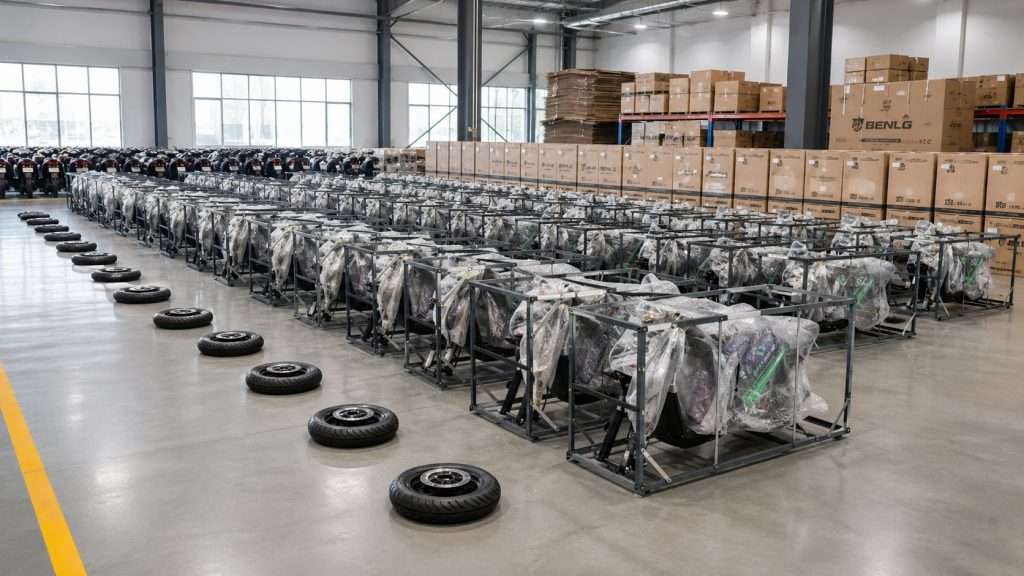 BENLG factory floor showcasing electric motorcycles secured in protective iron frames under the SKD (Semi-Knocked Down) method, to maximize container loading capacity.
CKD (completely-knocked-down) — Pros: the highest units per container and the lowest freight per unit; in some markets a lower duty band applies, and local assembly can create jobs and qualify for incentives. Cons: the most demanding option — assembly space, trained labour, quality control and a warranty process all become yours, and you cannot assume that a knocked-down shipment attracts a parts rate. Duty treatment depends on local tariff classification, the rules governing sets of parts, origin requirements and local assembly policy, and those rules can leave a knocked-down shipment assessed at the finished-vehicle rate. Best for: operators targeting volume who can handle assembly and who have confirmed the classification with a customs broker.
4.3 Battery: type, capacity, replaceability and honest range
Battery selection determines cost, weight, range, service life and — critically — your certification status. Four checks matter more than the rest.
- Type. Lead-acid is cheaper, heavier, shorter-lived, and easier for informal workshops to service. Lithium is lighter, longer-lasting and more expensive. Both are viable in the same market; which one suits a given customer depends on how they charge, how far they ride and how they intend to handle a pack at end of life.
- Capacity and voltage. Size the pack for the job it actually has to do each day. A delivery rider covering 80 km a day needs a fundamentally different pack from a commuter doing 12, and the advertised range figure will not tell you which one you are looking at. Ask for the capacity in kWh or Ah, the chemistry, and the usable energy rather than the nominal figure — then check that a full day’s riding fits inside it with some margin for a cold morning or an ageing pack.
- Replaceability. Ask whether the pack is a standard form factor that can be sourced independently, whether it is swappable, and how long a replacement takes to arrive. In fleet use, a battery that cannot be replaced locally is an operational failure waiting to happen.
- Real range. Manufacturer range figures are measured unladen, on flat ground, at moderate speed, in mild weather. Loaded and in heat, expect to derate by 20–35%. Quote your customers the derated number; it protects your reputation and your warranty.
One procedural warning worth repeating: changing battery capacity or specification may affect a vehicle’s type-approval status, depending on the approved configuration and the applicable regulations. Manufacturers should confirm with the relevant approval authority whether the change requires updated documentation, additional testing or an extension of the existing approval. If you plan to offer a capacity upgrade, establish its certification consequences before homologation, not after.
4.4 Motor, controller, brakes and build quality
- Motor: rated power, often referred to as continuous rated power, is the power level a motor is designed to sustain under specified operating and thermal conditions. Peak power refers to the highest output the motor or drive system is specified to deliver under defined conditions, usually for a shorter duration than continuous operation. When comparing electric scooters, do not evaluate performance by peak power alone — consider rated power alongside peak power, torque, acceleration, hill-climbing ability and performance under the intended load. The actual result also depends on the battery, controller, motor design, gearing and thermal management. For commercial buyers, check how the supplier defines and documents both rated and peak power: a peak-power figure without its operating conditions or duration may provide an incomplete basis for comparing vehicles, so ask for both on the specification sheet and on the nameplate.
- Controller: ask which make and whether it is a sealed unit with a stated IP rating. Controllers are among the components worth stocking for routine electrical repairs, alongside batteries, chargers, throttles and wiring connectors.
- Brakes: drum brakes are cheap and easy to service; disc and combined braking systems stop better. Match the braking system to the speed the vehicle can actually reach.
- Suspension and frame: check that the frame welds are finished rather than ground down to hide porosity, and that the suspension is serviceable rather than sealed and disposable.
- Tyres: confirm the size is a common one available in your market. An odd tyre size turns a flat into a three-week wait.
4.5 Certification, labelling, documents and market access
The table below is a preliminary screening list, not a compliance plan. In this product category, compliance is not a matter of obtaining a certificate with the right name. It depends on how the vehicle is classified, which whole-vehicle approval route applies, whether an import licence or product certificate is required, how the goods are labelled, how they are taxed and whether any exemption applies. Every route below must be confirmed for your specific vehicle, configuration and market by a local importer, customs broker or the competent authority before you place an order.
| Market | Compliance routes to investigate | What is usually involved | Common pitfall |
|---|---|---|---|
| Nigeria | SONCAP | Product certification and shipment certification are separate steps; the scope depends on whether the product is regulated | Treating the two certificates as one, or assuming every product category is automatically in scope |
| Kenya | KEBS PVoC (pre-export verification of conformity) for applicable imports | Conformity verification before shipment; exemptions and alternative handling routes exist for certain goods | Reading PVoC as a blanket requirement with no exemptions, or as a scheme that covers East Africa as a whole |
| Saudi Arabia | SASO requirements administered through the SABER platform | Product and shipment certificates issued electronically | Assuming Saudi requirements represent the requirements of every Gulf state |
| Mexico | NOM conformity assessment | Standards-based assessment and labelling appropriate to the product category | Treating a NOM reference as a single whole-vehicle approval for every scooter configuration |
| Brazil | INMETRO conformity assessment | Mandatory conformity assessment, often with local representation requirements and the longest lead time of this group | Underestimating timelines, or assuming certification can run in parallel with shipping |
| Indonesia | SNI, plus local-content rules where applicable | National standard marking and, for some categories, local content conditions | Assuming a standard mark alone secures import clearance and registration |
| EU / EFTA | Vehicle type-approval route determined by legal class (for example L1e or L3e) | Class-specific approval with a certificate of conformity; a 25 km/h, 250W pedelec falls under bicycle rules instead | Assuming one approval route covers every seated scooter, or that “EEC type approval” and “CoC” are interchangeable terms |
Two further cautions. Regional schemes are not region-wide: East African requirements differ between member states, and Gulf requirements differ between Saudi Arabia and its neighbours, so “KEBS and EAC marks” or “SABER” should never be treated as a single pass for a whole region. And a conformity mark or national standard is a starting point for import, not a guarantee that the vehicle can be registered, insured and sold. Build the certification step into your timeline rather than treating it as paperwork: a common pattern is 40–45 days of production after deposit, plus a significant additional period where homologation is required. If your business plan assumes stock on the floor in six weeks and approval takes three months, the plan is wrong.
5. Calculate Your Electric Scooter Business Costs and Margins
Scooter economics are unforgiving in one specific way: the unit price is low, so every fixed cost is spread over more units and every percentage point of margin matters more. Work through the five calculations below before you place an order. The numbers in the example are illustrative planning assumptions — replace them with your own quotes, but keep the structure.
5.1 Landed cost per unit
Everything follows from this number. Landed cost is what the scooter actually costs once it is sitting in your warehouse, ready to sell.
Landed cost per unit = FOB price + international freight + insurance + import duty + clearance & port charges + inland transport
Note that duty is normally assessed on the CIF value (goods plus freight plus insurance), not on the FOB price, and that the vehicle price and the battery may be declared separately.
Container capacity comes before every other number in a landed-cost model. How many units fit in a 40’HQ is not one figure — it depends on the model category and on the packing form, and it changes the freight and duty allocation on every unit in the box. Our standard loading is set out below.
| Units per 40’HQ, by category | SKD (semi-knocked-down) | CKD (completely-knocked-down) |
|---|---|---|
| Simple / e-bike style | 168 (large cartons) / 288 (small cartons) | approx. 300–350, depending on model |
| Full-size seated scooter | approx. 75 | approx. 150 |
| Cargo tricycle | 40 | 60 |
Three things follow from that table. First, it is quoted on a knocked-down basis: a container of complete units carries fewer, because assembled scooters occupy more space than the same machines boxed in parts — so a CBU count sits below the SKD figure for the same model. Second, the spread between the smallest and the largest category is more than fourfold, which means a landed cost calculated on an e-bike-style unit count and then applied to a full-size scooter will be wrong by a wide margin. Third, capacity is per model: a mixed container of two to four models does not average out cleanly, because the mixer has to load around the largest cartons. Ask your supplier for the carton dimensions and the units per 40’HQ for every model in your mix, in the packing form you are actually buying, and build the model on those numbers — not on a figure carried over from a different model.
The example below therefore uses a single-category container: 75 full-size seated scooters per 40’HQ, shipped SKD, at an average FOB price of USD 500.
| Cost line (per 40’HQ, 75 full-size seated scooters, SKD) | Amount | Per unit |
|---|---|---|
| Goods, FOB (average) | USD 37,500 | 500 |
| Ocean freight and insurance | USD 4,125 | 55 |
| Import duty (20% of CIF, illustrative rate) | USD 8,325 | 111 |
| Clearance, port and inland transport | USD 1,800 | 24 |
| Landed cost | USD 51,750 | 690 |
5.2 Capital tied up by order size and model mix
Landed cost is not your total requirement. Add the cost of the spare-parts kit, any import deposit or duty you must pre-fund, and several months of operating expenses until stock converts to cash. Recognise also that a container designed for fast turnover ties up less capital than the same value spread across slow premium models — one more reason to weight the mix toward the tier that turns fastest in your market.
5.3 Retail price, dealer margin and operating cost
Two margins matter in a scooter business, and confusing them is common. If you sell at retail you earn the retail margin; if you wholesale to other dealers you earn the distribution margin.
Gross margin per unit = Selling price − Landed cost
Dealer margin % = (Dealer price − Landed cost) ÷ Dealer price
At an illustrative USD 690 landed cost, a retail price of USD 1,050 leaves USD 360 per unit; a wholesale price of USD 900 to another dealer leaves USD 210. Bear in mind that both are gross margins: they have not yet paid for anything that varies with each sale. That distinction matters, and Section 5.5 shows why it changes the break-even number.
5.4 After-sales, spare parts and warranty cost
Budget for it explicitly rather than discovering it. A first-order spare-parts kit covering batteries, tyres, brake pads, controllers, chargers, throttles and displays is commonly quoted at roughly 1% of order value and is normally supplied with the shipment. Treat that as a starting estimate with conditions attached rather than a standard: the appropriate figure depends on the models, the battery chemistry, road and load conditions in your market, and how far your service network has to reach. A fleet-heavy or remote market needs a larger initial kit, and the number should be revised upward once you have your own failure data. Allow for more than the initial kit in year one regardless, because a warranty claim costs the part, the labour and part of the customer relationship — a cost of sale, not an exception.
5.5 Break-even and the pessimistic scenario
Two calculations answer the question every first-time importer asks: how many do I need to sell, and how long until I get my money back?
Break-even units per month = Monthly fixed costs ÷ Contribution margin per unit
Simplified cash payback (months) = Total capital invested ÷ Monthly net cash flow
The formula only holds if the figure you divide by is a contribution margin — revenue minus every cost that varies with the sale — and not a gross margin. The USD 360 calculated in Section 5.3 is a gross margin. It does not yet account for sales commission or payment processing, the warranty accrual, delivery or installation, or any other per-order cost. Suppose those together come to USD 90 per unit sold at retail. The contribution margin then becomes USD 270, and the break-even number moves:
- Using the gross margin of USD 360 → USD 3,200 ÷ 360 = about 9 units per month — the simplified, and optimistic, view
- Using a contribution margin of USD 270 → USD 3,200 ÷ 270 = about 12 units per month
The monthly fixed cost figure of USD 3,200 used here is itself an example assumption for a small retail operation, not a budget to adopt. A wholesaler with a warehouse, delivery vehicles and technicians will be substantially higher. Build your own from line items you can adjust, and re-run the break-even each time a cost moves:
- Rent and utilities
- Staff and workshop costs
- Marketing and administration
- Local delivery and vehicle expenses
- Insurance and other recurring costs
On that basis, and taking an initial capital requirement of about USD 70,000 (the first container landed, the spare-parts kit and the working capital to run until stock converts to cash), stress-test the plan at 1.3×, 1× and 0.6× of your base sales rate. The figures below are a simplified cash illustration only — before tax, financing costs, inventory replenishment and any movement in stock levels — and the payback shown is a simplified cash payback period, not a full return-on-investment forecast:
- Optimistic (1.3× — 29 units/month): monthly net cash flow about USD 4,630; simplified payback near 15 months.
- Base (1× — 22 units/month): monthly net cash flow about USD 2,740; simplified payback near 26 months.
- Pessimistic (0.6× — 13 units/month): monthly net cash flow about USD 310; simplified payback far beyond any reasonable horizon — a business that is technically profitable and commercially stuck.
Notice how much the answer moves between the two margin definitions. At the base sales rate, dividing by the gross margin of USD 360 would suggest a payback of about 15 months; dividing by a realistic contribution margin of USD 270 gives closer to 26 months. That gap is the reason to be precise about which margin you are using. The difference between a viable scooter business and an expensive hobby is rarely the margin on one unit — it is whether volume clears the fixed cost base by enough to survive a slow quarter. If your pessimistic case does not pay back within a horizon you can live with, either reduce the fixed cost base before you start or shift the model mix toward configurations with a higher contribution per unit.
Not sure what a container of scooters actually costs to land in your market? Send us your target country, the models you are considering and your expected first-order quantity, and we will come back with a landed-cost estimate and a suggested model mix rather than a catalogue. Request a quote →
6. Importing, Certification and After-Sales Support
This section covers the operational mechanics between placing an order and delivering a working scooter to a customer. Most of it is preparation, and most of the failures that cost first-time importers money happen here rather than in the showroom.
6.1 CBU versus SKD and CKD
Complete units arrive ready to sell and carry the highest freight and duty per scooter. Semi-knocked-down shipments reduce shipping volume, and completely-knocked-down shipments reduce it further and may attract a lower duty band — but that outcome is conditional, not automatic. Tariff treatment depends on local HS classification, the rules governing sets of parts, origin requirements and local assembly policy, and those rules can leave a knocked-down shipment assessed at the finished-vehicle rate. Never assume that splitting a consignment into parts will produce a parts rate. Compare total landed cost per unit for each mode, including the labour, space and quality control you will need, before assuming CKD is cheaper. Our CBU, SKD and CKD shipping guide walks through the documentation for each.
6.2 Duties, shipping and local compliance
- Incoterms. FOB can provide greater control over freight selection and cost visibility when the buyer has an experienced freight forwarder. Compare it with other suitable Incoterms based on who controls transport, where risk transfers, and which costs are included in the quotation — a smaller importer without logistics experience may find a delivered arrangement easier to manage, even if it is less transparent.
- Duty basis. Confirm the HS code and whether duty is assessed on FOB or CIF, and whether the battery is declared separately. A wrongly declared battery can stall a container for weeks.
- Battery transport. Lithium packs ship under dangerous-goods rules with specific packaging and documentation; lead-acid is generally easier but still subject to conditions. Our bulk shipping and battery compliance guide covers the practical requirements, including the UN classification your forwarder must use.
- Documentation set. Bill of lading, commercial invoice, packing list, certificate of conformity or test report, and whichever import permit or product certificate your market requires. Assemble it before the vessel sails, not after.
- Payment terms. The standard structure in this trade is 30% deposit with the balance against a copy of the bill of lading, or an irrevocable at-sight letter of credit. See our B2B payment terms guide for how to negotiate the terms without exposing yourself.
6.3 Spare parts, diagnostics and repair training
In this business, a well-planned spare-parts inventory is essential to reducing downtime and supporting repeat business. Start with the parts identified by the manufacturer’s service records and your local pilot fleet, then adjust stock levels as real failure data accumulates rather than guessing at a stock list on day one.
- Start with the parts that most often generate a repair ticket: batteries, chargers, throttles, controllers, display units, tyres and tubes, brake pads and shoes, wiring connectors, and the wheel or hub motor. The exact mix varies with the model, the battery chemistry, road and load conditions and build quality, which is why the first range should follow the manufacturer’s own service experience rather than a list copied from another market.
- Learn to diagnose before you learn to repair. Electrical faults in a scooter most often trace back to the battery, the controller, the throttle or a connector. A systematic diagnostic sequence turns a two-day workshop visit into an hour.
- Get assembly and repair training. Manufacturers normally supply assembly documentation and remote video guidance, especially for CKD programmes; take that support seriously and record the sessions for your own technicians.
- Decide your warranty policy in writing. What is covered, for how long, what voids it, and how a claim is processed. An informal warranty is a permanent argument.
6.4 Building a local dealer and after-sales network
If you are distributing rather than retailing, your reach depends on dealers who can sell and service in their own towns. Appoint by territory rather than by whoever asks first: a dealer with an exclusive area has a reason to invest in demonstration stock and training. Support them with a stock rotation policy, a spare-parts kit sized to their market, and a clear escalation route for warranty claims. Visit them — a territory with an unvisited dealer is a territory you do not actually have.
7. Running and Growing an Electric Scooter Business
Purchasing stock is the easy half. Whether the business earns money depends on how you run it — and the operating playbook is not the same for a retail dealership as for an importer or regional distributor. The two share suppliers, spares and cash constraints, but they earn their money in different ways, so this section treats them separately before covering the functions they have in common.
7.1 Retail dealership operations
Setting up the physical operation. Scooters are compact, which is a genuine advantage for a first-time operator — you can present a credible range in a modest space. The right size depends on your market and rent levels, but a showroom and workshop of roughly 110–170 m² (1,200–1,800 sq ft) is enough to display 20–30 units and keep a service bay. Four decisions shape how well the space works:
- Visibility beats floor area. A busy street frontage with eight well-lit scooters outside will outsell a large unit on a side road. In most scooter markets the customer passes on foot or on a two-wheeler — they need to see you.
- Separate selling from fixing. A workshop bay in plain view of customers signals that the product is serviceable, but the noise and dirt should not reach the display area.
- Plan charging and battery storage from day one. You need a charging area with adequate ventilation and a fire-safe arrangement for battery storage; lithium packs in particular require sensible separation and a suitable extinguishing method. Treat this as a safety requirement, not an aesthetic one.
- Design the demonstration. One unit on a raised platform with a clear price tag, and one unit explicitly available for test rides. Being allowed to sit on and ride the scooter converts more customers than any brochure.
Creating retail demand. Retail sales in these markets are won locally, not through broad advertising:
- Lead with test rides and a visible signboard. In most of these markets the first sale in a neighbourhood comes from someone who saw the shop and rode the scooter.
- Work with whoever offers consumer credit or instalment plans locally. Affordability, not desire, is the binding constraint on the entry tier — a payment plan often multiplies your addressable market.
- Run “ride to work” demonstrations at offices, campuses and factories. A single lunchtime demo can generate several enquiries from the same employer.
- Use the channels your customers actually use. In much of Africa, Latin America and Southeast Asia that means Facebook, WhatsApp and local marketplaces rather than search engines — post delivery and collection videos, price lists and finance options.
- Ask every buyer for a referral. Scooter ownership is social; a satisfied customer is the cheapest marketing you will ever buy.
Service and retention. A scooter sale is the beginning of a service relationship, and retention is where profit compounds. Schedule a free first service so the customer returns within a month and early faults are caught before they become warranty claims. Offer periodic battery health checks — the owner’s main anxiety, and a natural high-margin service visit that also tells you when a replacement is due. When a customer comes back for a battery or a major repair, the conversation about a newer model is already open; a trade-in programme turns that into a sale. Keep the high-frequency spares in stock so the customer never has a reason to go elsewhere, and build some form of owner community — a group chat, a visible relationship, a monthly ride — because that is what turns buyers into referrers.
7.2 Wholesale and distribution operations
If you are importing to supply other dealers rather than end users, the work is different in kind. Your customers are businesses, your product is availability, and your main risks sit in the channel rather than in the showroom.
- Dealer recruitment and territory coverage. Appoint dealers by territory, and be deliberate about whether the arrangement is exclusive. An exclusive dealer has a reason to invest in demonstration stock and training; an open territory invites price competition between your own customers. Track coverage by district and visit your dealers — an unvisited dealer is not really a dealer.
- Order volumes and replenishment cycles. Agree with each dealer what they will order, how often, and what the replenishment lead time is. Dealers reorder when stock runs out, not when you would like them to, so your own buying plan has to be built around their cycles and around seasonal peaks rather than around container economics alone.
- Dealer margin and a regional price architecture. Publish a dealer price and protect it. Nothing destroys a distribution network faster than one dealer in a neighbouring town undercutting the others because they bought cheap or are clearing dead stock. Decide in advance how you will handle a dealer who wants to sell outside their territory.
- Inventory financing and receivables. Wholesale businesses fail from unpaid receivables more often than from slow sales. Set credit limits and payment terms per dealer, enforce them consistently, and watch the age of what you are owed as closely as the level of stock you are holding. If you offer consignment, price the risk into the terms.
- Dealer after-sales capability. A dealer who cannot service what they sell damages your brand, not just their own. Support them with a parts kit sized to their market, technical training and a written escalation route for warranty claims, and treat their service gaps as your problem to close.
- Avoiding stock pile-up downstream. Sell into demand, not into warehouses. Policies that push dealers to take models they cannot sell produce returns, discounting and dead relationships — and the returned stock becomes your problem again, at a worse price. Where a dealer has over-ordered, it is usually cheaper to help them sell it than to take it back.
- Fleet and institutional supply. Approach delivery platforms, courier firms, rental operators and institutional buyers with a written cost-per-kilometre comparison against petrol, not a specification sheet. Offer a small pilot batch with a service commitment attached — fleet buyers rarely order a hundred units cold; they buy ten, watch them run for a month, then scale. Set service commitments that match your actual warehouse coverage, local stock levels and delivery distance rather than promising a fixed window you cannot hold everywhere.
7.3 Turning enquiries into orders
Whatever model you run, the enquiry is where the margin is won or lost — and the retail counter and the wholesale desk need different answers. Decide in advance what your written reply contains in each case; improvising it is how a well-stocked business still fails to sell.
At the retail counter. A scooter is rarely an impulse purchase, and the conversation goes badly when the first question is about price. Establish four things before you talk money: what the buyer will use the vehicle for, how far they ride in a day, what they will carry, and whether they can register and charge it where they live. Those four answers pick the tier, and the tier picks the model.
- Put the battery position in writing. Whether the price includes a pack, and which chemistry and capacity, is the single most common source of dispute in this trade. Quote it both with and without.
- Settle the trade-in question early. A large share of retail buyers are replacing an existing vehicle; knowing that changes both the price conversation and your used-stock policy.
- Log every enquiry, including the ones that do not buy. Where a scooter is a considered purchase, a lead that goes quiet in March frequently buys in June. Record the model discussed, the reason for hesitation and a follow-up date.
- Follow up on a schedule rather than when you remember. Two or three structured follow-ups recover a meaningful share of buyers who were simply waiting for payday.
At the wholesale desk. A dealer enquiry is a business conversation, so answer it with business information rather than a price alone. Your reply should state the dealer price and the margin it leaves them, the minimum order and the replenishment lead time, how the territory is defined, how a warranty claim is handled and who handles it. Send the spare-parts list together with the price list — a dealer who cannot see the parts and the margin will not commit to a first order.
In both channels, the answer that converts is a written one. A quotation that states the model, the battery position, the price basis, the lead time and the warranty terms lets the buyer compare you properly with another supplier; a price sent as a chat message rarely survives the comparison.
7.4 Managing cash and inventory as you grow
Growth in this business is constrained by cash, not by demand. Three habits keep it under control. First, track inventory turnover by model and reorder on a trigger — for example when stock of a fast-moving model falls below a set number of weeks of sales — rather than on feeling. Second, resist the temptation to hold every model in depth; carry breadth in the fast tier and depth only in the models you have proved. Third, hold a deliberate proportion of your working capital in spare parts and warranty provision, because that is the part of the business that produces repeat customers. An importer whose showroom is full and whose parts shelf is empty has built the wrong inventory — and if you are running a distribution model, the same discipline applies to receivables, which are cash you have already spent.
8. A Practical Checklist Before Placing Your First Order
Before you commit capital, confirm each of the following in writing. If any item is unresolved, it is a risk you are choosing to accept — decide that deliberately rather than discovering it later.
- Market validation. You have visited existing dealers, confirmed the street price of new and used petrol scooters, and established the fuel-versus-electricity cost per kilometre in your city.
- Legal classification. You know which class your intended models fall into in your market, and therefore what licence, registration, insurance and approval route applies.
- Model selection. You have chosen tiers rather than individual models, evaluated them on price, battery, compliance, payload and expected turnover, and written down a mix ratio you are prepared to revise.
- Container capacity. You have the supplier’s actual packing specification — carton dimensions and units per 40’HQ — for every model in the mix, and you have not assumed a single unit count across different models.
- Sample testing. You have ridden a sample unit loaded, on a representative road, and measured the real range against the claimed figure.
- Supplier audit. You have verified licences, seen recent production footage, confirmed monthly capacity and obtained references in your region.
- Quote comparison. You have at least two complete quotes on the same Incoterm, with the battery priced separately where applicable, and you know the landed cost per unit for each.
- Compliance confirmation. A local importer, customs broker or competent authority has confirmed the classification, approval route, import requirements, labelling and tax treatment for your models — not just the name of a scheme.
- Contribution margin. You have calculated break-even using contribution margin rather than gross margin, and you know how many units a month the business needs to clear its fixed costs.
- Spares and warranty. You have a first-order spare-parts kit sized to your market, a written warranty policy, and a person who can carry out repairs.
- First order. You have confirmed the deposit and balance terms, the production and shipping schedule, and the date by which the stock will be sellable.
The purpose of the checklist is not caution for its own sake. It is to make sure that when your container arrives, the only remaining problem is selling scooters.
9. Why BENLG Is Your Strategic Partner for Electric Scooter Success
BENLG is the export brand of Dongguan Benling Vehicle Technology, a two- and three-wheeler manufacturer established in 2003. We build and export electric motorcycles, electric mopeds, seated electric scooters, moped-style e-bikes and electric cargo tricycles, and we supply importers, distributors and fleet operators across Africa, the Middle East, Latin America and Southeast Asia.
For scooter buyers specifically, that means a few practical things. We quote FOB with the battery priced transparently rather than buried in the vehicle price, so you can see what you are actually paying for. We supply complete units, private label and OEM/ODM programmes, and SKD or CKD kits where the duty structure makes them worth examining. Our standard minimum order is one full container, and we routinely mix two to four models in a single container so that a new dealer can test several tiers before committing to depth. Every shipment leaves with a spare-parts kit, and we support assembly and repair with documentation, video guidance and remote technical help. For distributors building a territory, we offer regional arrangements against an annual volume commitment.
If you are working through the calculations in this guide and want a real number rather than a range, tell us your target country, your expected first-order quantity, the tiers you are considering and whether you intend to sell under your own brand. We will respond with a landed-cost estimate and a suggested model mix — not a catalogue.
Talk to our export team about your scooter business →
📚 Further Reading
- How to Start an Electric Motorcycle Business — the broader guide to market assessment, funding and dealer economics across two- and three-wheelers.
- How to Import Electric Bikes, Scooters and Mopeds from China — the end-to-end import workflow, supplier vetting and documentation.
- Moped Scooter Sourcing Guide for Electric Moped Dealers — specification-level selection across types and configurations.
- Types of Scooters: A Complete Guide — the body styles and how they differ.
- Electric Delivery Scooter Buyer’s Guide for Fleet Importers — procurement logic for delivery and rental fleets.
- Moped-Style E-Bike B2B Sourcing — the licence-free alternative in markets with strict moped rules.
Send us your target market, planned order quantity, preferred model tiers and whether you want your own brand. You will get a landed-cost estimate and a recommended product mix, prepared by someone who has shipped this product into your region before.
📩 Contact the BENLG export team | 💬 WhatsApp is answered during China business hours.
Written by Li Yan, export content lead at BENLG. Li Yan works with importers and distributors across Africa, the Middle East, Latin America and Southeast Asia on vehicle selection, certification planning and landed-cost modelling.


