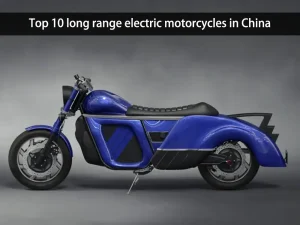
An electric motorcycle is a motorcycle whose only source of propulsion is an electric motor drawing from an on-board battery. There is no combustion engine, no fuel system and no gearbox in the conventional sense — which changes not only how the machine is built, but how it behaves, how it is rated and where its limits sit.
This page works from the inside out. It starts with what happens to energy between the battery and the rear wheel, because every specification further down — voltage, amp-hours, watt-hours, continuous power — only means something once that path is clear. The components follow, then how the machine behaves in use and how long it lasts.
What is an electric motorcycle
An electric motorcycle is a two-wheeler built to motorcycle standards — frame stiffness, suspension travel, braking performance and road-holding at highway speed — with an electric drivetrain in place of an engine. It is registered as a motorcycle, and it is ridden on a motorcycle licence.
Three other vehicle types are often discussed alongside it, and they are not variants of the same thing so much as separate categories with separate rules:
Electric moped — a lighter class capped at 45–50 km/h in most markets, with its own certification and a light licence. Different frame, different brakes, different homologation.
Electric bicycle — a pedal-assisted bicycle, limited to 250 W and 25 km/h in most jurisdictions and usually exempt from registration. It is a bicycle with assistance, not a motorcycle with a smaller motor.
Electric cargo tricycle — three wheels, a load bed, and a different set of stability and braking problems.
What distinguishes the electric motorcycle technically is not the absence of an engine but the shape of its power delivery. An electric motor produces its maximum torque from zero speed, so there is no need for a clutch or a multi-speed gearbox to keep the engine in its power band. The machine accelerates on a single reduction ratio, and the rider controls torque directly rather than through gear selection. That single fact explains most of the differences covered on this page.
How does electric motorcycle work
The drivetrain is not a chain of parts but a control loop, and understanding it explains almost every characteristic of the vehicle — why it pulls from a standstill, why it has no gearbox, why its top speed is capped by voltage, and why it slows down when you close the throttle.
From stored charge to rotation
The battery stores energy as direct current at a voltage that falls as the pack discharges. The motor cannot use direct current. It needs three alternating phases, and two separate things about those phases matter: their frequency sets how fast the motor turns, and the current flowing through them sets how much torque it produces. Something has to convert one into the other while adjusting both, hundreds of times per second, and that is the controller’s entire job.
The controller switches the direct current across three outputs in a rotating sequence, synthesising a magnetic field inside the motor. Raise the switching frequency and the field rotates faster, so the rotor follows faster. Raise the current and the magnetic force between stator and rotor grows, so torque increases. Speed and torque are controlled independently — which is the single reason an electric motorcycle needs no clutch and no multi-speed gearbox, and why maximum torque is available at zero speed.
Why voltage caps the speed
A spinning motor is also a generator: the faster the rotor turns, the higher the voltage it induces internally, opposing the supply. Once that induced voltage approaches the pack’s voltage, current can no longer be forced into the motor and acceleration stops, no matter what the controller is rated for. This is why system voltage — not motor power alone — sets the ceiling on speed. It also explains why a 72 V machine and a 48 V machine with the same rated motor can end up far apart at the top end.
Why it feels smooth at walking pace
At very low speed the controller is switching at a tiny fraction of its capacity, and the precision of its rotor position measurement decides whether torque arrives evenly or in steps. Early controllers switched in square waves, which produced audible noise, heat and a lurch off the line. Modern units synthesise a sine wave and align the applied field with the measured rotor angle — field-oriented control — which is why the same motor can feel refined on one machine and crude on another.
What happens when you close the throttle
The motor is still connected to the wheel, so it is still turning, so it is still generating. The controller can either let that energy dissipate as heat or rectify it and return it to the pack, and the amount it can return is limited by how much charge current the cells will accept at their present temperature. A cold pack accepts little, so regenerative braking is deliberately weak until the pack warms. On a heavy machine working stop-start routes, the energy recovered this way is a measurable share of what was spent accelerating.
For the engineering beneath this — cell chemistry and state-of-charge estimation, phase versus bus current, hall sensor behaviour and failure modes, the diagnostic order a workshop should follow — see how do electric motorcycles work.
Main components and performance parameters of electric motorcycle
With the energy path established, the specification sheet becomes readable: each figure describes one point on that path, and each assembly exists to solve a problem created by the one before it.
What the key parameters measure
System voltage (V). The pack’s nominal voltage — commonly 48, 60 or 72 V — sets the speed ceiling described in the previous section, and for a given power it sets how much current must flow. Power is voltage multiplied by current, so a 72 V system carries two-thirds the current of a 48 V system at the same wattage; lower current means less resistive loss in the cables and less heat in the controller.
Capacity (Ah) and energy (Wh). Amp-hours describe charge, not energy. Energy is voltage multiplied by amp-hours, so a 60 V 30 Ah pack stores 1,800 Wh. Two packs with the same amp-hour figure at different voltages hold different amounts of energy, which is why comparing amp-hours across vehicles tells you nothing unless the voltage is stated with it.
Motor power (W). Two ratings exist and are not interchangeable. Peak power is the brief maximum before thermal protection intervenes; continuous power is what the motor can hold indefinitely without overheating its windings. A motor advertised at 3,000 W peak with a 1,000 W continuous rating is a 1,000 W machine on any long climb or sustained headwind, and continuous rating is the figure that predicts loaded behaviour.
Torque at the wheel. What moves the vehicle is wheel torque, not motor torque. A hub motor drives the wheel directly, so the two are equal. A mid-drive passes through a reduction stage, multiplying torque by the ratio at proportional cost in speed — which is why a mid-drive with modest motor torque can out-pull a higher-rated hub motor on a gradient.
The assemblies on that path
The motor converts electrical energy into rotation. In a hub configuration it sits inside the rear wheel, eliminating the chain or belt and the space a mid-drive needs, at the cost of unsprung mass: wheel, motor and brake all move with the suspension, and a heavier wheel follows broken surfaces less well. A mid-drive sits in the frame, keeps unsprung mass low and allows the reduction ratio to be chosen for the duty, which is why load-carrying designs tend to use it.
The battery pack stores energy and, through its voltage, sets the speed ceiling. Cells in series build voltage; cells in parallel build capacity, so the same cell can produce a 48 V 40 Ah pack or a 72 V 27 Ah pack of similar energy with very different behaviour. The pack also contains a battery management system that watches cell voltages and temperature, balances cells against each other and disconnects the pack when a limit is exceeded. A pack without a working BMS is a fire risk, not a power source.
The controller performs the conversion described above. Its defining characteristics are the current it can pass continuously and the quality of its output waveform. Ingress protection matters here more than on any other component, because the controller carries the highest current density on the vehicle and sits where water and vibration reach it.
The frame carries the pack, the rider and, on working machines, a load. Because the pack is heavy and sits low and central, frame design is largely a question of where that mass goes and how stiffly it is held — a pack mounted high, or allowed to move, changes the handling far more than the same mass would in a fuel tank.
Suspension controls how the wheels follow the road, and its job is harder here than on a petrol equivalent because hub-motor designs add mass to the wheel that the spring and damper must control. Travel, in millimetres, is the figure that determines whether a loaded machine absorbs a pothole or runs out of movement and passes the impact into the frame.
Brakes stop the machine and, on this drivetrain, work alongside the motor — the regenerative braking described in the previous section handles a share of the deceleration and returns it to the pack, with friction brakes covering the rest.
The instrument cluster and wiring connect the systems. Beyond the display, what matters technically is the communication bus: speed, state of charge, temperature, fault codes and controller state all travel between units, and a machine whose wiring is documented can be diagnosed from that data rather than by substitution.
The usable life of an electric motorcycle is set by its battery, because every other assembly either outlasts the pack or is replaceable at low cost. For a machine in daily service that works out to roughly five to eight years on a lithium pack, or 60,000 to 110,000 km, before the pack falls to 80% of its original capacity — the point at which range has dropped far enough that most operators replace it. Lead-acid machines land well below that.
Those ranges are not a warranty; they follow from two figures that can be checked on any specification sheet.
Where the number comes from
A pack’s cycle life is quoted by its cell manufacturer as the number of full charge cycles before capacity falls to 80%. The order of magnitude differs sharply by chemistry:
Chemistry
Typical cycles to 80%
What that means in service
Lithium iron phosphate (LFP)
2,000–5,000
Longest service life; heavier for the same energy
Nickel manganese cobalt (NMC)
1,000–2,000
Lighter and more compact; shorter cycle life
Lead-acid
300–500
Cheapest to buy; tolerates deep discharge worst
Multiply cycles by the distance covered per charge and the answer falls out. A pack rated 2,000 cycles in a machine that covers 60 km per charge gives roughly 2,000 × 60 × 0.9 ≈ 110,000 km, the factor of 0.9 allowing for declining capacity across the pack’s life. The same machine used on a delivery route that returns to base and recharges twice a day covers the same total distance in under three years rather than five and a half — the pack ages on cycles, not on the calendar.
This is the calculation worth running against any quoted range: it converts a marketing figure into a replacement date.
What shortens it
Three things move a pack away from its rated life. Heat is the largest: calendar ageing roughly doubles for every 10 °C of sustained storage temperature, so a machine parked in direct sun in a hot climate ages on a shorter clock than the same machine in shade. Deep discharge is the second: a pack repeatedly run to empty and left there loses capacity faster than one kept between roughly 20% and 80%. Fast charging at temperature extremes is the third, because pushing current into cold or hot cells accelerates the internal damage that the BMS is trying to limit.
The parts that are not the pack
Everything else on the machine is a wear item with its own interval, and confusing those intervals with the vehicle’s life is a common mistake. Tyres, brake pads and wheel bearings are replaced several times over the life of one pack, and their cost is part of normal operation rather than a sign of the machine reaching its end. The motor itself normally outlasts the pack by a wide margin: with no brushes, no oil and few moving parts, its service life is governed by bearing condition and by insulation degrading under sustained heat, and bearing noise is the first sign it needs attention.
What actually decides whether a machine reaches its expected life is whether the operator can see the pack degrading. A state-of-health reading, or a service interval that measures delivered capacity rather than resting voltage, turns a gradual decline into a planned replacement instead of a roadside failure.
How fast does an electric motorcycle go
Top speed follows from available power against resistance, and at the speeds these machines run the resistance is dominated by air. Drag rises with the square of speed, so the power needed to overcome it rises with the cube: doubling speed takes roughly eight times the power. That single relationship explains the whole spread of the category.
What each power level delivers
The table below is calculated, not surveyed: it solves for the speed at which motor output equals the sum of aerodynamic and rolling resistance, assuming a typical rider-and-machine frontal area of about 0.6 m², a combined mass of 150 kg, and level ground without wind. Real machines vary around these figures with bodywork, tyre choice and rider weight, but the shape of the curve does not.
Continuous power at the wheel
Sustainable top speed
What it suits
1.5–2 kW
around 55–60 km/h
Inner-city delivery, dense traffic
3 kW
around 70–75 km/h
Urban and peri-urban commuting
5 kW
around 85–90 km/h
Inter-urban routes, faster arterials
8 kW
around 100 km/h
Highway-capable light motorcycle
13 kW and above
120 km/h and beyond
Highway touring, performance machines
Two caveats turn these into real-world numbers. The first is that continuous power, not peak, is the relevant figure — a machine rated 5 kW peak but 2 kW continuous sits on the second row, not the third, once the controller begins limiting after a minute or two of sustained load. The second is that the table assumes a full pack: as state of charge falls, pack voltage falls with it, and since voltage is what pushes current through the motor at speed, top speed drops. A machine that holds 90 km/h at full charge may hold noticeably less at 30%.
The advantages of an electric drivetrain are mostly consequences of two facts: an electric motor delivers torque from zero speed, and it does so at high efficiency across a wide range of speeds. Everything below follows from those.
Torque without a gearbox. Because maximum torque is available at a standstill, there is no clutch to slip and no gear to select. On a gradient with a load, the machine pulls from rest instead of being revved into its power band.
Efficiency that holds at low speed. A petrol engine is least efficient exactly where urban vehicles spend most of their time — idling, crawling, stopping and restarting. An electric motor draws almost nothing at a standstill and returns a large share of what it took to accelerate, through regenerative braking.
Fewer wear surfaces. No oil, no filters, no clutch plates, no exhaust. The service list shortens to tyres, brakes, bearings and the pack, and the intervals between workshop visits lengthen.
Silence and no tailpipe at the point of use. Relevant for night work in dense cities, and increasingly written into municipal and last-mile contracts rather than merely preferred.
Stable energy price. The cost per kilometre follows the local electricity tariff rather than the fuel market, which makes fleet operating cost easier to forecast even where it is not lower.
Three claims commonly made for the category do not hold up, and it is worth knowing why. A range figure quoted without a speed and a load is not a measurement. “Zero maintenance” is false — the pack degrades, and tyres, brakes and bearings wear exactly as they do on any vehicle. And the environmental case depends on how the local grid generates electricity, which varies from market to market and is worth stating honestly rather than assuming.
How does electric motorcycle charge
Charging an electric motorcycle is a controlled process rather than a simple connection, and the sequence matters for how long a pack lasts.
What happens during a charge
The charger first holds a constant current, pushing energy in as fast as the pack will accept. As cell voltage rises toward the pack’s absorption limit, the charger switches to holding a constant voltage and lets the current taper off on its own. The battery management system ends the cycle when current falls below a threshold, or earlier if any cell exceeds its temperature or voltage limit. Pushing past that point does not add usable range; it breaks the cells down.
Where the charger sits
Two arrangements are common. An on-board charger is built into the vehicle: the rider connects a cable to a socket and the vehicle manages everything. It is convenient and needs no separate unit to lose, but it adds weight and heat where the machine lives, and it must survive vibration for years. An external charger sits outside the vehicle and connects to the pack directly. It can be sized larger without adding vehicle weight, runs cooler, and is cheaper to replace — at the cost of being one more thing to carry, store and not leave behind.
Either way, the input voltage range matters more than the output rating. A charger designed for a stable 220 V supply behaves poorly on a network that sags under load, which is a normal condition on distribution lines outside major cities.
Where the vehicle charges
The location decides the practical charging speed more often than the equipment does. A domestic socket is limited by the circuit it sits on, so a charger rated above that circuit’s capacity will simply be limited by it. Workplace and depot charging allows a dedicated circuit sized for the purpose, which is why fleet operators usually charge overnight at a base rather than between trips. Public charging points vary widely in what they deliver. Battery swapping sidesteps the question entirely: the pack is exchanged rather than charged, so the stop takes minutes, but it requires the operator to standardise on one pack format and to carry the inventory.
Why the pack cannot simply be plugged into the mains
A charger is a power supply with current limiting, voltage regulation and communication to the battery management system — not an adapter cable. The pack needs to be charged at a rate matched to its temperature and state, and it needs to be disconnected if a cell misbehaves. A direct connection provides none of that protection.
How long a charge takes
The arithmetic is straightforward once the taper is allowed for. Energy in watt-hours divided by charger output in watts gives the bulk-charge time; the constant-voltage phase adds roughly a fifth to a third on top. A 60 V 30 Ah pack holds 1,800 Wh, so a 600 W charger needs about three hours for the bulk phase and closer to four for a full charge, while a 1,800 W unit takes roughly an hour plus taper.
Temperature modifies all of it. A cold pack accepts current slowly and a hot pack accepts less than its rating, so a machine charged outdoors overnight in a cold climate will take longer than the same machine charged indoors — a difference that shows up in fleet schedules and is rarely mentioned in a brochure.
What is the difference between an electric motorcycle and a traditional motorcycle
The two drivetrains solve the same problem with different compromises, and the differences that matter in service are structural rather than stylistic.
Dimension
Electric
Petrol
Peak efficiency
High across most of the operating range, including low speed
High only in a narrow band of engine speed
Transmission
Single reduction; no clutch, no gear selection
Clutch and multi-speed gearbox
Idling and stop-start
No consumption at rest; recovers energy when slowing
Consumes fuel at rest; energy lost as heat when braking
Wear items
Tyres, brakes, bearings, and the pack over time
Oil, filters, plugs, clutch, exhaust, and the engine itself
Refuelling
Time-bound by charging equipment and circuit capacity
Time-bound by station access
Energy cost
Follows the local electricity tariff
Follows the fuel market
Range sensitivity
Falls noticeably with load, gradient and cold
Falls less with load; largely unaffected by cold
End-of-life cost
Pack replacement is the dominant item
Engine and gearbox rebuild is the dominant item
The structural point behind the table is that a petrol drivetrain wastes energy whenever it is not at its design speed, while an electric drivetrain wastes comparatively little at any speed but is bounded by stored energy it cannot replenish quickly. Urban work with frequent stops favours the first characteristic; long continuous runs with no charging opportunity favour the second.
Which means the comparison that decides a purchase is total cost over the service the vehicle will actually do — energy, tyres, brakes, bearings and pack replacement, divided by kilometres covered — and that calculation has to be run on local prices and the operator’s own distance profile. A general answer does not transfer between markets.
Is an electric motorcycle worth it
Whether an electric motorcycle is the right machine for a given job comes down to four conditions, and all four can be tested before a purchase rather than discovered afterwards.
The distance profile. The pack has to cover the longest regular day, not the average one. A fleet that runs 40 km most days but 90 km twice a week needs the machine sized for 90 km, or a charging opportunity in the middle of those days.
Where the vehicle rests. A socket at the parking point changes the economics more than any specification. Without one, the operator is depending on a public charging network or on carrying a removable pack to a power source, and either dependency has to be verified rather than assumed.
What it carries and where it climbs. Payload and gradient together determine the power class. A machine sized for a solo rider on flat ground will not hold speed with a load on a hill, and the shortfall appears in service rather than in the showroom.
Who maintains it. An electric drivetrain needs less routine attention than a petrol one but needs different attention: diagnostics rather than tune-ups. Whether that capability exists locally decides how long a fault keeps the vehicle off the road.
Where all four line up, the case is arithmetic and the calculation can be shown to the buyer. Where one does not, the machine is wrong for that job regardless of how good it is in the abstract — and identifying that before the order is considerably cheaper than discovering it during the first month of service.
How to choose the right electric motorcycle for you
Choosing a machine is a process of narrowing by requirement before comparing by specification. The order matters, because a specification sheet cannot tell you whether a vehicle suits the job it is being bought for.
Narrow by requirement first
Four questions eliminate most of the field. What is the longest regular daily distance, including the worst day rather than the average? What payload must it carry, and up which gradient? Is there a socket where it will rest? And which licence class can the riders actually hold? Only after those are answered does comparing motor ratings or battery capacity mean anything.
Then pin the specification in writing
Eight parameters determine whether two machines are genuinely comparable, and all eight belong in a written specification rather than a conversation.
Parameter
What the figure should state
System voltage
Nominal pack voltage, and the voltage range over the discharge cycle
Battery energy
Watt-hours, cell chemistry, and whether the pack is removable
Motor
Continuous rating in watts, peak rating, hub or mid-drive, reduction ratio if mid-drive
Controller
Continuous current rating, control method, ingress protection rating
Chassis
Rated payload in kilograms, kerb weight, wheelbase, seat height
Running gear
Brake type front and rear, wheel and tyre size, suspension travel front and rear
Charging
On-board or external, output in watts, AC input voltage range
Documentation
Wiring diagram, fault-code list, and the certification naming this exact model
Two of these are where purchases most often go wrong. The certification has to name the model being shipped — a certificate covering a related model does not cover this one, and neither customs nor a registration authority will treat it as if it does. And the documentation set decides whether a fault in month eight can be diagnosed locally or turns into a parts shipment and a stationary vehicle.
An electric motorcycle is mechanically simpler than a petrol one and behaviourally different in ways that follow from a single fact: an electric motor makes its torque from zero speed. No gearbox, no clutch, full pull from rest, and a speed ceiling set by voltage rather than by displacement.
Those differences change what a buyer needs to compare. Voltage and energy in watt-hours describe the machine; continuous motor rating describes how it behaves under load; and the certification naming the exact model describes whether it can be registered at all.
With a focus on SEO and extensive writing skills, I have been active in the writing for many years and good at writing dynamic industrial pieces and popular scientific articles. At the same time, it’s my fifth year in the two-wheeler and related industries. I have worked with my team on numerous significant projects and trainings, and very familiar with our product. Still in the process of continuous learning, I have always maintained a sense of new things to ensure that the content of the article is timely and innovative.
Electric motorcycles continue to develop to occupy a large part of the market share. Because of their rich functions and environmental protection to attract many consumers. This article will introduce the top 10 electric motorcycle companies in the world.
To help you make an informed decision, we’ve compiled a list of the top 10 best motorcycle tires in the world. We have also summarized FAQs about tire quality, and how to choose and maintain the tires to guide you to the perfect tire selection.
High frequency users such as food deliverers and couriers require long range electric motorcycles. This article collates the top 10 long range electric motorcycles in China, with a range of between 250 and 610 kilometers, far beyond the ordinary electric motorcycle.